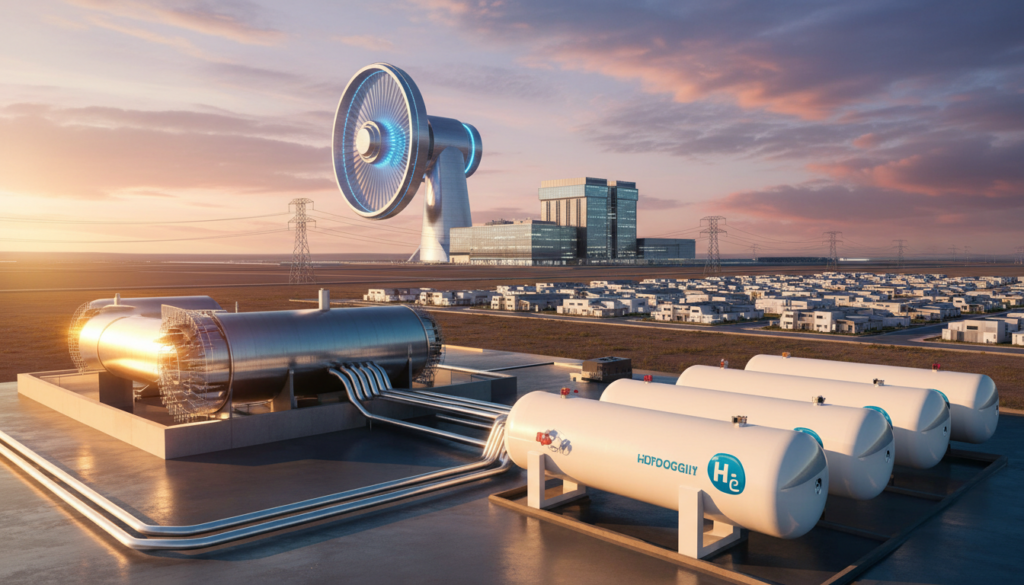
The new Jupiter I turbine, made by the Chinese company MingYang Group, runs only on hydrogen. It is now the largest hydrogen-fueled unit of its kind in the world, which raises new questions about how far the energy transition can go without coal or fossil gas.
A hydrogen turbine that isn’t like anything else on the grid
Jupiter I is not a windmill. It is a huge gas turbine that was built from the ground up to run on nothing but hydrogen. Its rated capacity is 30 megawatts (MW), which is the highest ever reported for a pure-hydrogen turbine working in real-world conditions.
When it is at full load, the machine can use up to 30,000 cubic meters of hydrogen per hour. Engineers like to say that this is like having a dozen Olympic-sized swimming pools full of gas go through the system in just 60 minutes.
Jupiter can make enough electricity every hour to power about 5,500 average homes without using any fossil fuels.

The turbine works in Inner Mongolia, China, where wind and solar farms already make a lot of electricity that changes all the time. That setting is perfect for testing because there are times when there is too much renewable energy and times when there isn’t enough.
Why solar panels and wind farms aren’t enough for grids
Solar and wind power often make the news, but grid operators have a technical problem that won’t go away. When there is a lot of sun and wind, renewable farms can make more electricity than the system can use. When that happens, operators have no choice but to cut back on production and throw away clean energy that could be used.
Batteries that are big help, but they are still expensive and rely heavily on minerals that are hard to find. Storing enough electricity for whole regions for days at a time is still a stretch for the economy and the supply chains that are available.
This is where hydrogen comes into play. When the grid is flooded with cheap or unwanted power, that electricity can be used to split water into hydrogen and oxygen through electrolysis. The hydrogen turns into a kind of chemical battery that can be stored in tanks or underground caves and moved by truck or pipeline.
From hydrogen that is stored to electricity that is ready to use
The hard part is turning hydrogen back into electricity. Fuel cells can do that without burning, but they tend to be slower and work better with steady, predictable loads than with sudden spikes in demand.
Power grids are always on the edge of failure. Consumption can change in seconds: lights come on at night, factories speed up, and air conditioners roar during a heat wave. Operators need generation assets that can start up quickly and change their power levels on command to deal with this.
That is the niche where hydrogen turbines like Jupiter I aim to fit: combining the responsiveness of conventional gas plants with a fuel that, when produced from renewables, can be almost carbon-free.
Jupiter I doesn’t burn methane or coal; instead, it burns pure hydrogen and mostly releases water vapour from its exhaust.
Inside Jupiter I: burning hydrogen on a large scale
In broad terms, Jupiter I works like a standard gas turbine. Hydrogen is mixed with air and ignited in a combustion chamber. The expanding hot gases spin turbine blades connected to a generator, producing electricity.
But substituting hydrogen for natural gas is far from a simple fuel swap. Hydrogen flames burn faster and hotter. The gas is lighter, diffuses more quickly, and can destabilise materials. Uncontrolled, it raises risks of flashback, where flames travel backward into the burner, and of accelerated wear in hot components.
Engineering challenges behind the “super turbine”
According to technical descriptions, MingYang’s engineers had to rethink several core parts of the design:

- Combustion chambers reshaped to stabilise the faster-burning hydrogen flame.
- Internal aerodynamics adjusted to manage different gas flow patterns and mixing behaviour.
- Cooling and thermal management reinforced to cope with higher peak temperatures.
- Control systems upgraded to monitor pressure, temperature and flame dynamics in real time.
The result is a 30 MW turbine that can run continuously under industrial conditions, rather than just in a laboratory. In combined-cycle configuration—where waste heat is recovered to drive a steam turbine—Jupiter I reportedly reaches electricity production of around 48,000 kilowatt-hours per hour of operation.
Climate impact that shows up on the balance sheet
The developers say that, at equivalent power output, Jupiter I avoids more than 200,000 tonnes of carbon dioxide emissions each year compared with a conventional fossil-fuelled thermal plant.
Beyond its direct output, the turbine allows nearby wind and solar farms to run more often, instead of being switched off when the grid cannot absorb their power.
That second effect matters. Without flexible backup, high-renewable grids frequently sacrifice potential clean energy during periods of oversupply. A device that can soak up surplus electricity as hydrogen and later turn that hydrogen into firm power changes the economics of new solar and wind projects.
| Aspect | Conventional gas turbine | Jupiter I hydrogen turbine |
|---|---|---|
| Main fuel | Natural gas (methane) | Pure hydrogen |
| Direct CO₂ emissions | High | Near zero (with green hydrogen) |
| Typical role | Peaking / baseload with fossil gas | Grid balancing with stored renewable hydrogen |
| Technical challenge | Mature, well-understood | Flame stability, materials, safety |
Rethinking what “dispatchable” clean power looks like
For decades, electricity that grid operators can “dispatch” on command came from three main sources: coal plants, gas plants and nuclear reactors. All three can be controlled to match demand, with varying degrees of flexibility.
Jupiter I points to a different template: dispatchable power without fossil carbon, driven by a simple molecule produced using electricity from wind, solar or even nuclear reactors.
That does not make hydrogen a silver bullet. Producing it requires large quantities of electricity and water. New pipelines, storage facilities and safety protocols add costs. The climate benefits depend entirely on how the hydrogen is made; if it comes from reforming natural gas without effective carbon capture, emissions remain high.
Green, blue, grey: the colour code behind the fuel
Energy debates often use a colour shorthand for hydrogen types:
- Grey hydrogen: produced from fossil fuels with no capture of CO₂, high emissions.
- Blue hydrogen: still fossil-based, but paired with carbon capture and storage to reduce emissions.
- Green hydrogen: produced by electrolysers powered by renewables (or sometimes nuclear), with very low lifecycle emissions.
A turbine like Jupiter I only delivers its full climate advantage when fed with green hydrogen. That, in turn, depends on large-scale deployment of renewables and electrolysers, and on policies that support their integration.
What this means for future power systems
For countries wrestling with how to phase down coal and gas while keeping the lights on, record-setting hydrogen turbines change the menu of options. They sit somewhere between batteries and traditional gas peaker plants: fast, flexible and, at least in principle, compatible with a low-carbon trajectory.
One plausible scenario for the 2030s sees regions dominated by cheap wind and solar, backed by a mix of short-duration batteries and hydrogen-fired turbines like Jupiter I for longer or deeper supply gaps. Such a system might run the hydrogen plants relatively rarely, but rely on them as a form of insurance against calm, cloudy days or unexpected spikes in demand.
There are risks alongside the promise. Hydrogen is a tiny molecule that can leak more readily than methane, and leaks can affect both safety and climate, since hydrogen indirectly influences atmospheric chemistry. Communities near new hydrogen hubs will want credible oversight of storage, pipelines and industrial sites.

Still, the combination of large-scale hydrogen storage with fast-ramping turbines offers a tangible route to stabilise power systems built around renewables. Inner Mongolia’s Jupiter I unit shows that this approach has moved beyond glossy concept art into operating hardware—capable, at least already today, of keeping thousands of homes supplied without relying on fossil gas.