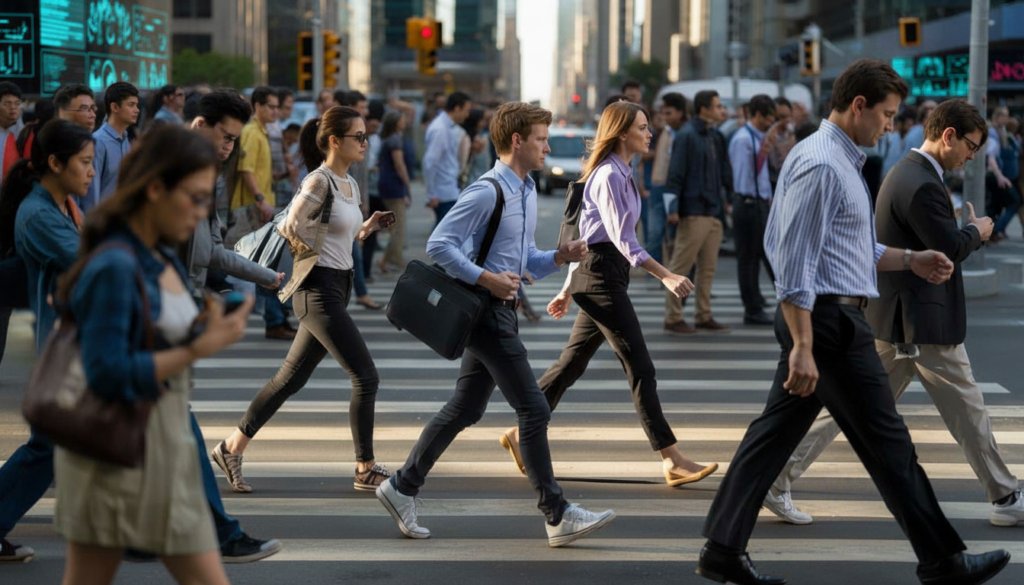
A few days ago, I did something strange at a busy crosswalk. When the light turned green, I didn’t just walk. I quietly timed the people around me. One woman in sneakers walked through the crowd like she knew exactly where she was going in life. A man with a briefcase followed quickly, keeping his eyes on the road and his steps sharp. A small group of people behind them walked slowly, dragging their feet like the day was already too heavy. They all had phones in their hands.
I saw who smoothly avoided obstacles, who hesitated, and who looked lost.
And that’s when a strange idea came to me.

The way we walk might be saying more about us than we realize.

What your walking speed says about your brain without you knowing it
Behavioral scientists have been looking into this for years, quietly keeping track of how quickly people move through streets, hallways, and even hospitals. When they plot the data, a clear pattern keeps coming up. People who walk faster than average tend to do better on cognitive tests and say they have better lives.
Not walking at Olympic speed. That sharp, purposeful pace you see in people who look like they have somewhere to go.
It’s not about being in a hurry or stressed out. It’s about how fast your brain takes in information and then turns it into action.
Researchers at Duke University tracked almost 1,000 people from birth to middle age. When those people turned 45, scientists tested their brains, biological age, and even how fast they could walk. The people who walked faster didn’t just look healthier. Their brains looked younger on scans, and they did better on tests of memory and reasoning.
Another group of studies in the UK looked at older people and found that those who walked more slowly were more likely to have health problems and die earlier. The feet were basically sending a quiet warning to the body.
What seems like a random quirk starts to look like a subtle, moving MRI of your life.
What causes this to happen? One part of the answer is “processing speed.” That’s the ability of your mind to quickly take in information, sort it, and respond. A brisk walker is always paying attention to their surroundings and making changes to avoid people, traffic lights, uneven sidewalks, and dogs on leashes.
That chain from brain to muscles is shorter and more direct. Faster decisions are made. Without drama, actions follow.
Over time, this rhythm becomes habits: being on time, acting on ideas, and not staying in doubt for too long. Your walking speed is a kind of everyday measure of how quickly you make decisions, face problems, and take advantage of opportunities.
Can you teach yourself to “walk like a successful person”?
You can do a simple test on yourself this week. When you walk somewhere by yourself next time, like to the store, the bus, or from the parking lot to the office, pick up the pace a little. Not so fast that you have to breathe heavily, just 10–15% faster than usual.
Raise your chest. Let your arms move freely. Not glued to your phone, but looking around.
Pay attention to how different the world feels when your body says, “I’m going somewhere on purpose.”
A lot of us don’t realize how much our body language and speed affect our thoughts. When we feel defeated, we drag our feet, which makes us feel even more defeated. A nasty little loop.
You don’t have to change your whole life in one night. Take short, planned walks to your next meeting, during your lunch break, or while walking the dog. Pick one path in your day and act like it’s a little training ground.
To be honest, no one does this every day. But if you do it three times a week, your baseline pace will start to change on its own.

One behavioral scientist I talked to put it in a way that stuck with me.
She said, “Your walking speed is one of the few things that shows how your brain works and how much you want to be a part of the world.” “You can’t pretend for long.” But you can move it along slowly.
- To turn that into something practical, think of a tiny “walk upgrade” checklist:
- Choose one route to take every day and promise to go a little faster on that part only.
- Put your phone away while you walk so your brain can really take in what’s around you.
- At least once a week, walk with someone who naturally walks quickly.
- Instead of scrolling, use your walk to practice a choice or thought.
- Keep track of how you feel after ten minutes of walking quickly on purpose—energy, clarity, and mood.
When to walk slowly as a sign and when to do it on purpose
There’s something wrong with all of this, and it matters. Not everyone who walks slowly does so because they don’t have drive, intelligence, or ambition. Someone’s stride can show that they have chronic pain, an illness that isn’t visible, depression, or just plain tiredness. Just because someone walks slowly doesn’t mean they don’t think.
We’ve all been there: when your body just won’t go along with your plans.
The people who are moving the most carefully down the street are sometimes the bravest people in the room.
What scientists are really pointing to is a broad pattern, not a moral ranking. Across giant groups of people, faster walkers tend to have sharper cognitive scores and more successful life markers – better jobs, higher incomes, longer, healthier lives.
Context is everything for each person. The same person who walks slowly on a Sunday might run through the airport like a bullet when the flight is about to leave. The environment, the stakes, the energy of the day all feed into your pace.
*So the question isn’t “Am I doomed if I walk slowly?” but “What does my usual pace say about my current season of life?”*
There is also culture. In some cities, like New York or Tokyo, a “normal” pace would be considered aggressive elsewhere. In small towns, community and conversation matter more than shaving 30 seconds off a commute.
Still, behavioral scientists keep coming back to the same plain truth sentence: **People who habitually move with purpose tend to build lives that reflect that purpose.**
The feet are telling the truth. Over years, they trace out who you are when nobody’s watching.
**Your walk is not your destiny, but it’s one of the clearest body-language signals your future self is already sending.**
What your own pace might be trying to tell you
So maybe the real invitation here isn’t to obsess over how many seconds it takes you to cross a street. It’s to notice your “default” walk in different areas of your life. How do you move when you head into work, versus when you walk toward a passion project? Does your pace slow near certain people, certain buildings, certain tasks?
That gap is where the story lives.
If walking faster feels more alive, more you, that’s a clue worth listening to. If slowing down feels like relief, that’s a clue too. Somewhere between the power walk and the slow shuffle lies a tempo that matches a life you actually want to live.

| Key point | Detail | Value for the reader |
|---|---|---|
| Walking speed reflects brain processing | Faster walkers often have quicker cognitive processing and younger-looking brains on scans | Helps you see your everyday pace as a subtle signal of mental sharpness |
| You can gently train your pace | Small, regular “brisk segments” in your day shift your default speed over time | Gives you a simple, low-effort way to boost energy and focus |
| Context and health still matter | Slow walking can also signal fatigue, illness, mood, or cultural norms | Protects you from harsh self-judgment and invites a more nuanced self-audit |
FAQ:
Is walking fast really a sign of being smarter?On large population studies, people who walk faster tend to score higher on cognitive tests, but that doesn’t mean every slow walker is less intelligent. It’s a trend, not a rule for individuals.
What counts as “fast” walking?Many studies use around 1.2–1.4 meters per second (roughly 4–5 km/h), but in daily life a “fast” walk is simply a pace that feels purposeful and slightly challenging without making you gasp.
Can I change my walking speed long term?Yes. Regular brisk walking, even in short bursts, can shift your natural pace over weeks and months as your fitness, confidence, and decision speed improve.
What if health issues keep me from walking fast?Then walking speed is more of a health indicator than a success marker. Focus on whatever movement feels safe and sustainable for your body and talk to a professional if your pace suddenly drops.
Should I judge people by how fast they walk?No. Walking speed is one clue among many and can be shaped by pain, culture, mood, or context. Use this insight to understand yourself better, not to label strangers on the sidewalk.