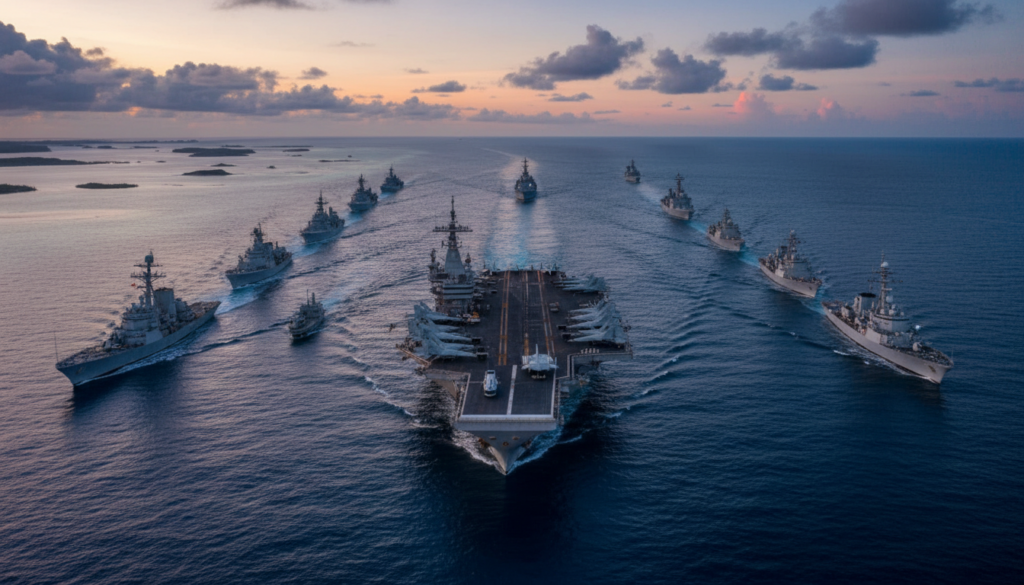
That morning, satellite images showed the sea as a flat blue pane with white wakes on it. But the surface peace felt very fake between the gray shapes of China’s newest warships and the lone US aircraft carrier cutting its way across the Pacific. The screens on the radar lit up. Radio stations were full of clipped English and Mandarin. No one shot. No one gave up.
On deck, the crews moved like they knew the world was watching, even though they couldn’t see the cameras. Traders on land kept an eye on oil prices as they moved with every rumor of a “near-collision.” Strategists updated ship-tracking apps like people check the weather before a storm.
There isn’t just one moment that is the flashpoint. It’s a steady stream.

A fight in slow motion in crowded seas
At first, the US radar only saw a faint blur of the Chinese destroyer. Then it looked like a gray wedge pushing low on the horizon, closer to shoals that both Beijing and Washington call “theirs” in different ways. The American carrier group kept an eye on it without making a sound, recording every change in course and speed. No music from Hollywood. The sound of engines and the nervous silence of people who know history is breathing down their necks again.
On Chinese state TV, anchors talk about a “routine patrol in China’s coastal waters.” In US press briefings, the same footage is shown as “increasingly aggressive behavior” in international waters. The ships are in the same body of water. The stories couldn’t be more different.
A few months ago, a Philippine resupply boat tried to get to soldiers who were on a rusting ship that had run aground on Second Thomas Shoal. Chinese coast guard ships came in, blasted water cannons, and cut across its bow at scary angles. Videos from the ship showed crew members holding onto rails while torrents slammed into windows. No missiles, no torpedoes. Water was used as a blunt weapon.
The US condemned “dangerous maneuvers,” sent more planes, and quietly told its allies that it would keep its treaty promises. Beijing made new maps, gave reefs new names, and made a louder claim that “external forces” were the real troublemakers. Within days, American and Chinese warships were sailing next to each other again, closer than most people would feel safe driving on a highway.
This is what a flashpoint in the twenty-first century looks like when no one wants to be the first to shoot. Every month, China pushes its huge fleet a few nautical miles deeper into waters that are disputed. It builds airstrips on reefs that were once empty and anchors coast guard ships where fishermen used to work alone. The US sends a single carrier strike group, a floating city of almost 5,000 sailors, as if to say, “This is where we draw the line.”
Both capitals say they are responding, not starting something. Beijing points to problems that have been going on for hundreds of years and foreign gunboats. Washington says that promises to “not militarize” the South China Sea have been broken. The rest of the world watches ships move around like chess pieces and quietly wonders who is really in charge.
Who’s making who mad, and how we got here
You need to zoom out from the steel hulls and look at the map to get a better idea of this slow collision. China’s claim is based on a broad “nine-dash line” that cuts deep into waters that other countries think of as their own. The US doesn’t say it owns these reefs, but it does say it has a mission: to keep sea lanes open for everyone, even its enemies, under what it calls “freedom of navigation.”
That’s why American carriers come like clockwork. They sail close to reefs that are in dispute, sometimes as close as 12 nautical miles, to send a clear message: this highway doesn’t belong to anyone. Beijing sees that as like driving a tank through your front yard just to “prove a point.” In Washington’s eyes, taking a step back once means taking a step back forever.
We’ve all been in that situation where two people stand in a doorway and won’t move first because “principle” is at stake. Now picture that door as a trade route worth a trillion dollars. About a third of all shipping in the world goes through these waters. Oil from the Middle East, microchips from Taiwan, and grain from Australia are all crammed into shipping lanes where Chinese missile ranges and US flight decks now overlap.
Japan, Australia, and South Korea watch these maps like neighbors who live next to a couple who is always fighting. If they make a mistake with the rudder or hear a radio command wrong, they could end up in a crisis they never wanted. But they need those waters to stay open just like you need your paycheck to come every month.
Let’s face it: no one really reads UN maritime law for fun, but that’s where a lot of this fight lives. In 2016, an international court sided with the Philippines and turned down most of China’s broad claims. Beijing didn’t care and called the ruling “null and void.” They just kept building. The US used the judgment as a legal shield but wouldn’t sign the treaty that made it possible.

So when a single American carrier sails toward a Chinese flotilla spread out over disputed reefs, both sides come with a lot of legal arguments and past hurts. *On the surface, the argument is about rocks and waves; underneath, it’s about who gets to make the rules for the century.* This is why even a “routine patrol” now feels like a fuse that is about to go off.
What this quiet crisis means for the rest of us
People in Manila, Sydney, or Los Angeles who are following along on their phones might find all of this to be background noise: more gray ships on blue water and more men in suits talking. One way to get past that numbness is to pay attention to what the markets do when things get tense. When Chinese jets fly close to a US patrol plane, the cost of shipping insurance goes up. When a US carrier says it will be deployed for a longer period of time, energy traders start to figure out how likely it is that the strait will be blocked.
One easy way to do this is to put a timeline of recent “incidents” next to graphs of oil futures, semiconductor stocks, or freight prices. Most of the time, the pattern is there. Every close call and near miss sends a small economic shock wave out into the world, long before any missile flies.
People often think that this is just “their” problem, something for admirals and presidents to worry about while the rest of us scroll past. That distance feels good until you realize how much of your daily life depends on calm seas between Guangdong and Guam. The screen on your phone, the battery in your car, and the cost of food when ships change course all depend on the idea that rival navies can dance aggressively without stepping on each other’s toes.
There is also a quieter emotional layer. People in the area have real memories, like grandparents who fled wars and parents who saw past crises in Taiwan or the Gulf. People don’t see a Chinese frigate crossing the bow of a US destroyer as an abstract chess move when they see it on social media. Are we sleepwalking into something that our kids will have to deal with up close?
A retired Southeast Asian diplomat told me not long ago, “Everyone asks who will shoot first.” “The scarier question is: what if no one shoots, but we keep living like this for twenty years?”
Be careful with the words. When officials use words like “red lines,” “core interests,” or “freedom of navigation,” it usually means that their positions are getting stronger, not weaker.
Follow the money: Defense budgets in the area are rising quickly, from submarines in Australia to missiles in Japan. That’s not acting; that’s getting ready.
Listen to the smaller voices. Vietnam, the Philippines, Malaysia, and the Pacific islands often see the danger most clearly because the giants are fighting in their front yards.
A world hanging over the edge, holding its breath
Tonight, young sailors on that US carrier and those Chinese destroyers will go out on deck for a breath of fresh air and look at the same dark waves. They didn’t make the maps. They didn’t write the speeches. But their lives might be the first to feel the effects if this slow-moving standoff ever turns into something faster and louder.
We are all still on the same ship, but the rest of us are farther back from the rail. When leaders frame a crisis as a test of national pride, people in their own countries often cheer. But then trade stops, prices go up, and relatives are called up. It’s not just “who is provoking whom” that matters; it’s also “who benefits if we keep arguing about that while the risk keeps rising.”
A real change in the Pacific won’t just be about land or weight. It will be measured by whether people outside of war rooms feel like they have a say before the next close call makes the news and people die. These far-off wakes and radar blips need more than a tired shrug and a doomscroll. Power is moving out to sea, slowly, stubbornly, and in plain sight. What we choose to see and ask of those in charge could determine whether this stays a test of patience or becomes one of those moments that history students memorize for all the wrong reasons.
| Key point | Detail | Value for the reader |
|---|---|---|
| Slow-motion flashpoint | Chinese fleet expansion and US carrier patrols are escalating without open conflict | Helps decode daily headlines and see the bigger pattern behind “incidents” |
| Economic stakes | One-third of global trade and key tech supply chains pass through contested waters | Connects distant naval moves to everyday costs, jobs, and technology |
| Narrative battle | Each side frames the other as the provocateur, using law, history, and media | Gives tools to question official stories and spot bias in coverage |
Questions and Answers:
Question 1: Why is the South China Sea such a dangerous place right now?
Question 2: Is it really likely that the US and China will go to war over these waters?
Question 3: What does “freedom of navigation” really mean in real life?
Question 4: If I live far from Asia, how might this standoff change my daily life?
Question 5: What signs should I look for that the situation is really getting worse, not just louder?