For a lot of families, the story got worse.
As governments in Europe and the UK push homeowners to use more eco-friendly heating, heat pumps have gone from being a niche technology to a big promise. But more and more users are complaining about high costs, inconsistent performance, and unexpected maintenance problems, despite the subsidies and fancy ads.
The price tag that makes people lose interest
For most families, the first problem is easy: money. A modern heat pump system, whether it gets heat from the air or the ground, is not cheap. Prices in France usually range from €10,000 to €20,000, which includes installation. In the UK and US, the cost of installing a complex system can be anywhere from £8,000 to well over £20,000.

That can easily cost more than a new gas boiler several times over. Grants and tax credits help, but they don’t always make the problem go away. And the gap feels even bigger in older homes that might need new radiators, better wiring, or a lot of insulation work before a heat pump will work well.

For a lot of families, the real cost isn’t just the pump itself, but all the upgrades that need to be made to make it worth it.
Heat pumps are affected by their surroundings. They work best in newer homes with good insulation and low-temperature heating systems, like underfloor circuits or big radiators. In a house with thin walls and single glazing, the same machine can have trouble, which makes it work harder and use more electricity.
A lot of frustration comes from the difference between what was promised and what actually happened. Two neighbours can put in similar units and get very different results just because one house keeps its heat in and the other lets it out.
Sometimes disappointing energy savings
A heat pump looks good on paper. Manufacturers stress the “coefficient of performance” (COP), which shows how much heat you get for every unit of electricity you use. Three units of heat for one unit of power sounds like magic compared to a resistive electric heater.
The picture is more complicated in real life. That headline COP usually comes from tests that aren’t too hard. On a cold January morning, when the outdoor unit is covered in ice, it may not work as well. The system uses more electricity to keep the house warm, and the promised 60% cut in bills can drop to 10–20% or even go away completely in homes that don’t match well.
Heat pumps save the most money when the building doesn’t lose much heat and the temperature outside stays in a normal range.
There is also the bigger issue of electricity prices. Compared to petrol, power is heavily taxed in France, the UK, and most of Europe. So, even if a heat pump uses less energy in kilowatt-hours, the bill doesn’t always go down in the same way.
When heat pumps work well and when they don’t
- New homes or homes that have been completely renovated and have good insulation: often a success story
- Older homes with bad insulation are more likely to disappoint.
- Mild to moderately cold climates: conditions are usually good.
- In very cold places where it freezes for a long time, performance drops more often
.These differences don’t mean the technology is “bad,” but they do mean it doesn’t work for everyone. The problem is that sales pitches don’t always mention those limits and say that the same solution is best for all types of buildings.
Maintenance: the line on the bill that isn’t there
There are compressors, fans, electronic valves, and refrigerant circuits in heat pumps, which are very complicated machines. They need to be checked on often, especially in places with a lot of dust, leaves, or pollution that can block outdoor units.
Common routine tasks include cleaning heat exchangers, checking refrigerant levels, inspecting electrical connections and testing safety devices. Because of the refrigerant gases involved, units with a capacity over a certain amount must be checked by a certified technician every year or two in many countries.
If you don’t do maintenance, your equipment will work less well at first and then break down later, which will cost you a lot of money.
Service contracts are another ongoing cost that can range from a few dozen to several hundred pounds or euros a year, depending on how complicated they are. Repair costs can be as high as those of a small used car when a key part, like the compressor, breaks.
Marketing often suggests that things will last for 20 years. In real life, some systems do get close, but others show serious wear after 10 to 12 years, especially if they are installed poorly or in harsh conditions. People who thought they could “fit and forget” technology sometimes feel tricked when they get big repair bills long before the two-decade mark.
A reputation hurt by making too many promises
Governments want heating to cut down on carbon emissions quickly. Manufacturers want to sell units. Installers want to work. In that situation, it’s easy to want to sell too much.
In both France and the UK, consumer groups have recorded complaints from homeowners who say they were promised huge savings with little mention of caveats: no clear explanation of insulation needs, limited discussion of electric tariff structures, vague or optimistic running-cost estimates.

When a technology is pushed as “ideal” without crystal-clear conditions for success, disappointment is almost guaranteed.
The biggest criticism targets a lack of tailored advice. Many households say they were guided toward a specific model or system size without a full heat-loss calculation of the building. Some discovered only after installation that radiators were undersized for low-temperature operation, or that the heat pump was too small to carry the whole load on colder days, triggering expensive electric backup.
What are the real options?
For homeowners trying to balance bills, comfort and emissions, the choice is rarely binary. It is not just “heat pump or nothing”. A more flexible strategy is emerging in several countries, where heat pumps become one tool among several.
Insulation first, technology second
Energy experts repeatedly stress one point: the cheapest energy is the energy you never use. That makes insulation and airtightness upgrades the foundation of any heating plan. Loft insulation, cavity wall filling, high-performance windows and simple draught-proofing can significantly cut heat demand.
That has a double effect. It lowers current bills with the existing system and increases the chance that a future heat pump will succeed. Once demand falls, a smaller, cheaper unit might be enough, and it will run less often in hard conditions.
Hybrid systems and local renewables
Some countries promote “hybrid” systems, where a smaller heat pump handles most of the heating load at mild temperatures, while a gas or oil boiler kicks in during the coldest snaps. This can avoid enormous upfront costs and reduce the risk that the heat pump alone cannot cope.
Another route involves pairing heat pumps with rooftop solar. When the sun provides part of the electricity, the effective running cost falls. Timing the heat pump to run more when solar output peaks can increase that benefit, especially with smart controls and home batteries.
| Option | Main benefit | Main limitation |
|---|---|---|
| Full heat pump system | Low emissions in suitable homes | High upfront cost, needs good insulation |
| Hybrid boiler + heat pump | Flexibility in cold weather | Still uses fossil fuel at times |
| Insulation upgrade only | Lower bills with any heating system | Does not decarbonise fully on its own |
| Heat pump + solar panels | Cheaper and cleaner electricity | Requires roof space and extra capital |
Key concepts homeowners should know
Two technical terms crop up constantly in heat pump debates: COP and seasonal performance factor (SPF). While they sound dry, they make or break the economics.
The COP, as mentioned earlier, is the ratio of heat output to electric input at a given moment under test conditions. The SPF goes further. It looks at average performance across a whole season, with all the ups and downs of real life. A system with a lab COP of 4 might deliver a seasonal factor closer to 2.5–3 in a cold, leaky house. That gap directly affects your bill.
Another crucial piece is the flow temperature, the heat of the water sent through radiators. Traditional boilers often run at 70–80°C. Heat pumps work more easily and efficiently closer to 30–45°C. If your radiators are sized for high-temperature water, they may not emit enough heat at lower temperatures, leading to either poor comfort or a system forced to run harder.
What a realistic scenario looks like
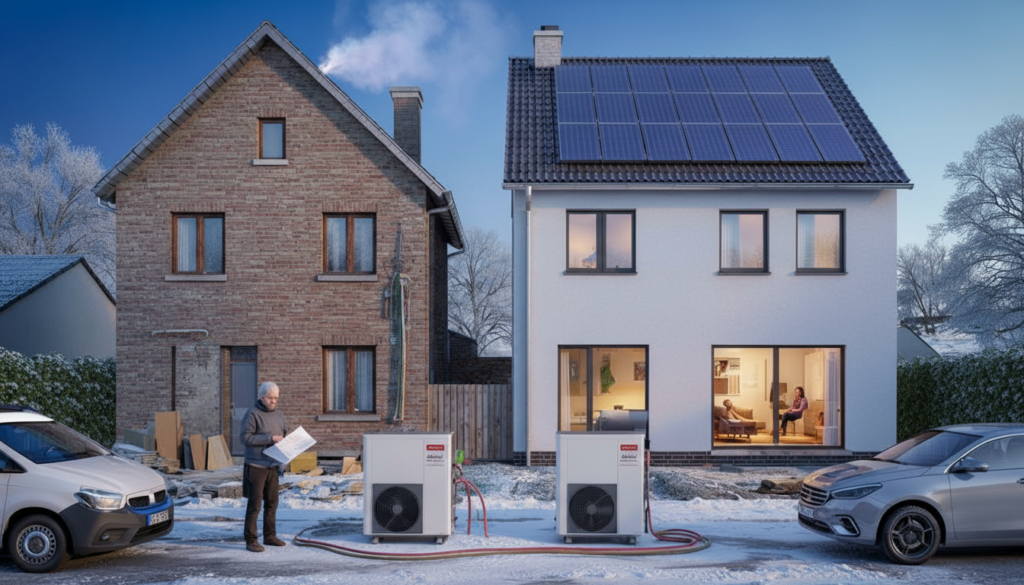
Imagine a typical 1970s three-bedroom house in northern England or northern France. The owner currently spends around £2,000 a year on gas or oil. An installer suggests a heat pump costing £13,000 fully fitted, hinting at savings of 40–50% on running costs.
If the owner invests nothing in insulation, and the building is quite leaky, the seasonal performance might struggle to hit the expected level. Bills might fall only modestly, perhaps by a few hundred pounds a year, lengthening the payback beyond 15 years. Any major repair during that period would erode gains.
Change just one variable and the story shifts. Suppose the owner first spends £5,000 on insulation and air sealing, cutting heat demand by a third. A smaller, slightly cheaper heat pump might then suffice, and the seasonal performance could reach a stronger level. Combined with rising fossil fuel prices, the payback period might shrink into the 8–12 year range, with better comfort and more stable long-term costs.
Risks, benefits and the long game
Rushing into a heat pump without a full building assessment carries several risks: underperformance, noisy operation from overworked outdoor units, unexpected electrical upgrades, and the psychological shock of a new bill that does not match the sales pitch.
On the other hand, when carefully designed and installed in the right setting, heat pumps do bring real advantages. They cut direct emissions at the home, they work with increasingly low-carbon electricity grids, and they shield households from some of the volatility of gas markets. For many urban areas facing air quality issues, removing combustion from homes also carries health benefits.

For now, the technology sits at an awkward crossroads. Some early adopters feel let down and vocal about it. Others quietly enjoy warm, cheap, low-carbon homes and say little. Between these two extremes, millions of households are trying to make sense of the conflicting stories, weighing high upfront costs against long-term savings, and wondering whether the “ideal” solution lives up to its name in their own street, with their own bricks and mortar.