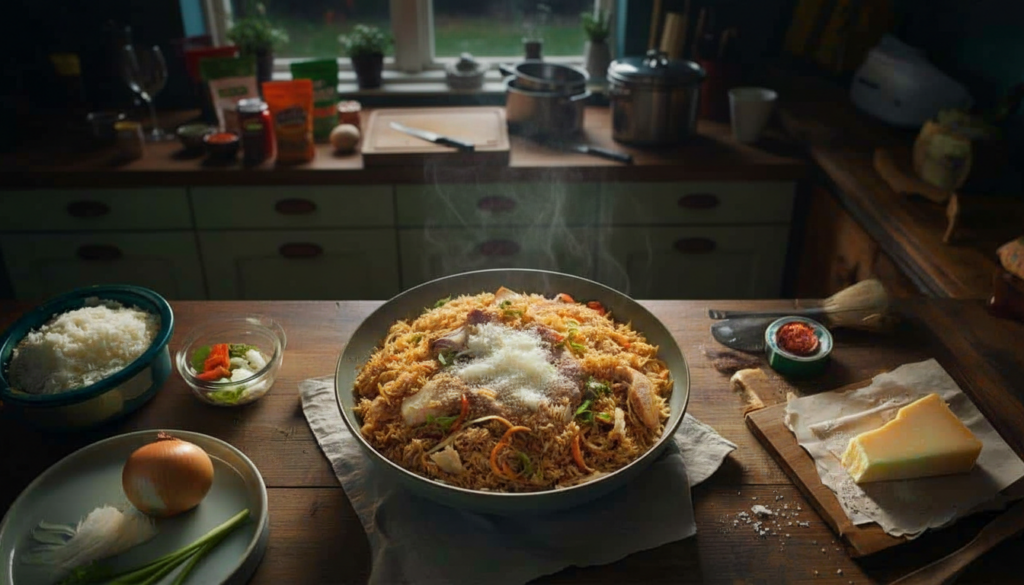
The plan was to make an omelette that was easy.
Not much, just eggs, cheese, and maybe a tired tomato if I could find one in the fridge. You put together this Tuesday night dinner while keeping one eye on your phone and the other on the clock. But when I opened the fridge, that plan fell apart right away. A half-roasted chicken. A bowl of rice that looks sad. A few sad vegetables, half-wrapped in crinkled plastic like they had given up days ago.
After ten minutes, I was stirring something that smelt really good.
I didn’t want the meal to end fifteen minutes later.
A lot of the time, the best dinners start with “uh-oh, what do I even cook?”
When you’re hungry, tired, and looking at a fridge full of ingredients that don’t seem to know each other, you get a certain kind of panic.
Everything looks random and nothing fits. You’re just two seconds away from ordering delivery again.

I was so close to closing the door and getting my phone that night when I stood in front of the open fridge light.
Instead, I took out the leftover roast chicken, a container of cold rice, a limp carrot, half an onion, and the small heel of a wedge of Parmesan cheese.
None of it made me feel inspired.

Then I smelt the roast chicken as I shredded it over the cutting board, and all of a sudden, everything made sense.
I thought, “rice fried.”
Not real, not perfect, just my version based on what I had in front of me.
I heated a pan, added the chopped onion with a little oil, and all of a sudden the kitchen felt less like a problem and more like a project.
The onion got softer, and then the carrot came next. It was cut into thin coins that looked much cuter in the pan than they did in the crisper drawer.
Next came the cold rice, which broke up under the spoon.
A splash of rice vinegar I didn’t remember I had, soy sauce, and a pinch of chilli flakes.
I pushed everything to one side, broke two eggs into the hot corner, scrambled them right there, and then folded them into the chicken and rice.
It wasn’t hard.
It wasn’t in the plans.
But when I grated the last bit of Parmesan on top and the steam carried the smell of that salty cheese through the room, I had that quiet feeling that this was going to be good.
Why does a meal that was thrown together feel better than one that was made with a recipe?
Partly, it’s about ownership.
You’re not just cooking; you’re figuring things out.
Using what you already have and getting life out of leftovers that seem like they’re on their last chance is also very comforting.
It’s not a lot of pressure.
You’re happy if it works.
If not, it was going to be trash anyway.
But those “accidental” recipes usually have everything our bodies want on a weeknight: they’re warm, salty, a little fatty, full of texture, and easy to eat from a bowl on the couch.
The reward feels surprisingly high because the bar is low.
Making a meal out of the mess in your fridge that you’ll remember all week
One simple move can change your mind from “I have nothing to eat” to “I just made something great.”
Ask yourself, “What base can I build?” instead of “What recipe can I follow?”
Your base is the shape you start with.
A big toast, a fried rice, a quick pasta, a loaded salad, and a sheet-pan hash.
Once you choose the base, the random things in your fridge become toppings.
My base that night was fried rice.
On another day, it could be thick toast with soft scrambled eggs and any vegetables that are still standing.
Different base, same ingredients, completely different meal.
*The secret isn’t magical ingredients; it’s a frame of mind that lets you be flexible.*
One of the biggest mistakes you can make is thinking you need the “right” version of an ingredient.
You don’t.
You need something that can do the same thing.
No green onions?
Cut up a little bit of regular onion very thin.
No fancy cheese?
That piece of cheddar at the back of the drawer will melt just as well.
No new herbs?
A squeeze of lemon, a grind of pepper, or even a chopped pickle can bring a dish to life.

We don’t give home cooking enough credit for how forgiving it is.
Let’s be honest: no one really does this every day.
We guess, we trade, and we wing it, and somehow, dinner happens.
The secret is to lean into the chaos on purpose.
What was it about that thrown-together fried rice that stuck in my mind all week?
It wasn’t perfect.
The rice was a little clumpy, the carrot was cut unevenly, and the Parmesan was a strange but tasty choice.
It was the feeling of having turned a small mess at home into something warm, filling, and really good.
No shopping.
No long list of ingredients.
Just a calm kind of resourcefulness.
I wrote a quick note in my phone that night: “Roast-chicken fridge rice—don’t forget how easy this was.”
I’ve made more complicated meals since then, but I still go back to that bowl.
It tasted like proof that I can take care of myself, even when I think I can’t.
- Choose “fried rice / pasta / toast / salad / hash” first, then think about how it tastes.
- Use things that are almost dead, like wilted greens, old rice, or the last spoonful of sauce. They taste great in mixed dishes.
- One thing that really wakes everything up is something sharp or salty, like cheese, pickles, chilli, lemon, or soy sauce.
- Add crunch at the end with nuts, toasted breadcrumbs, raw onion, or torn tortilla chips.
- Stop early: plate when it smells good and looks cosy, not when it looks like the picture in your head.
Making room for meals you didn’t plan
When we think of “good cooking,” we usually think of shiny, step-by-step recipes that were carefully chosen and timed perfectly.
That isn’t real life.
In real life, you come home late, open the fridge, and find that you have three half-empty jars of pesto and no energy at all.
It feels strangely freeing to let yourself improvise on those nights.
You are no longer failing to stick to a plan.
You’re just doing what you see.
Some nights, it will be a strange but good toast.
On some nights, the fried rice will taste like the best thing you’ve eaten in weeks.
You don’t have to take a picture of it.
You don’t have to write it down.
You won’t have to make it again.
But those wins that you didn’t plan for change how you see your own kitchen in a small way.
You stop seeing a messy fridge that is only half full and start seeing the beginning of something that could happen.
You begin to believe that you can walk in, tired and hungry, and still do the small miracle of feeding yourself well.
And every once in a while, without a recipe, a plan, or any pressure, you’ll make a meal that makes you scrape the bowl and say, “I really didn’t see that coming.”
| Key point | Detail | Value for the reader |
|---|---|---|
| Start with a base | Choose fried rice, pasta, toast, salad, or hash before picking flavors | Removes decision fatigue and turns random ingredients into a clear plan |
| Use “almost gone” food | Leftover protein, cooked grains, limp vegetables, jar ends | Reduces waste while creating surprisingly satisfying, layered dishes |
| Add one bold finisher | Cheese, lemon, chili, pickles, crunchy topping | Makes simple, improvised meals taste intentional and restaurant-level |
FAQ:
Question 1: How do I keep from making a boring “everything in the fridge” mess?
Answer 1: Stick to a base, like fried rice or pasta, and only add 3 to 5 main things: one carb, one protein, one or two vegetables, and one strong flavour, like cheese, sauce, citrus, or chilli. Keeping it simple makes it taste better.
Question 2: What kind of leftovers work best for this kind of recipe that you didn’t plan?
Answer 2: Cold rice or grains, roasted or rotisserie chicken, cooked vegetables, bits of sausage, jarred sauces and any cheese end are all great. You just have to reheat, season, and put them together.
Question 3: How can I tell if a leftover is still safe to eat?
Answer 3: In general, cooked food that is kept in a sealed container in the fridge for 3 to 4 days is usually safe to eat. If the smell is bad, the texture is slimy, or you’re not sure what to do for more than two seconds, don’t use it. Believe what you see and hear.
Question 4: What if I can’t think of anything to make in the kitchen?
Answer 4: Don’t be creative; just use simple formulas. For instance, “carb + protein + veg + something salty + something fresh.” Put in what you have. Herbs, cheese, eggs, toast, and tomatoes. Lemon, beans, spinach, Parmesan, and pasta. Same pattern, but different things.

Question 5: How do I make a recipe that I can use again and again?
Answer 5: Right after you eat, write down three quick things: the base you used, the main ingredients, and the one thing that made it special (a spice, a sauce, or a topping). You don’t need exact amounts, just a general plan you can follow next time.