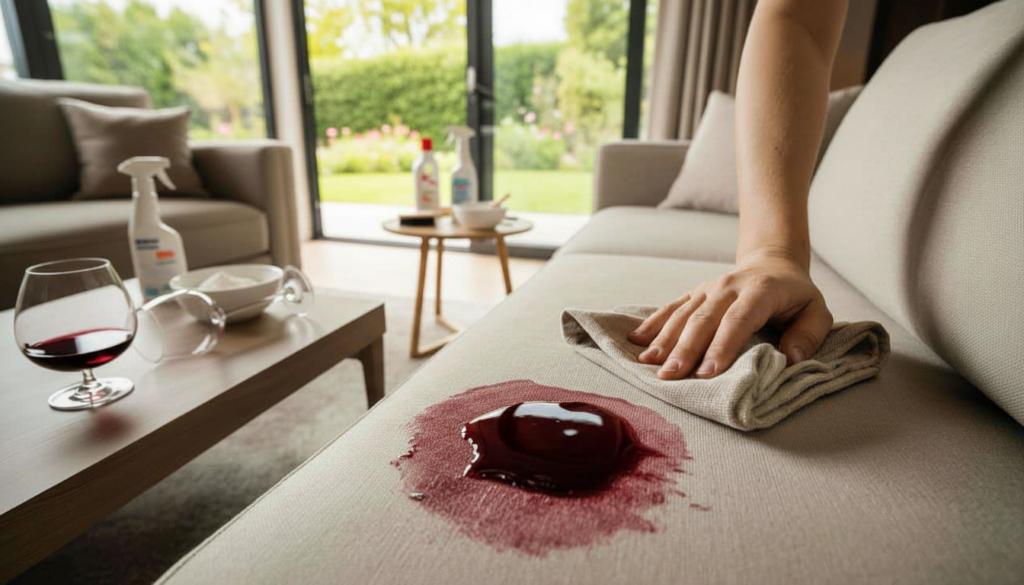
The glass tips, time slows down, and a dark ruby wave moves through the air.
You see it hit the light-colored fabric of your couch in what seems like slow motion, and then it explodes into little drops that look like stars.
Everyone around you gasps. Someone grabs a stack of paper towels, and someone else blames the coffee table. You feel that hot rush of “why tonight, of all nights?”
You dab, you freak out, you Google.
The stain fades a little, then dries into a ghostly pink halo that is worse than the original spill.
That ring is the real problem.
You can’t unsee it once you’ve seen it.

Why does red wine leave that ugly mark on your light-colored sofa?
The first thing you should do is grab something that will soak up the stain and attack it like it insulted your family.
You push, rub, and twist the fabric, hoping it will go away as quickly as it came.
The wine seems to sink into the light sofa, dark and stubborn, while the fabric around it starts to look… different.

That’s where the ring for the future starts.
The more you treat just the center of the cushion, the more it stands out from the rest of the cushion.
The stain changes position, gets lighter, and spreads.
When it dries, though, you get a pale, washed-out halo that screams “someone panicked here.”
Imagine a beige linen couch, a birthday dinner, and candles all over the place.
Your friend sits down too quickly, bumps the glass with their elbow, and all of a sudden there is a Bordeaux map on the cushion.
You do what we all do at that moment.
You take paper towels, rub them in small circles, add dish soap and hot water, and keep rubbing like a bad massage.
The wine and the fabric both get lighter.
The next morning, you can barely see the middle of the stain, but there is a pale, round mark around it that is a little bigger than your hand.
The texture of the fabric there looks a little rougher, like it has been scuffed.
The stain is “gone,” but every time you walk into the room, your eye goes to that ring.
The faded ring is just a sign that the cleaning wasn’t done evenly.
You only thought about a small, wet area instead of the whole cushion, and the fabric remembers.
If you only clean and rinse one piece of upholstery, it will look brighter than the rest, even if you rinse it a lot.
The way the fibres reflect light can change when they come into contact with soap, heat, or scrubbing.
In the end, you have three areas: one for the wine, one for cleaning, and one for not cleaning.
That line is right in front of your eye, and it looks just like a ring.
*The real trick is not just to get rid of the wine, but also to not make that border in the first place.*
The step-by-step guide to getting rid of the stain without leaving a ring
To begin, stop for three seconds.
Only three.
After that, use a clean, light-colored cloth or paper towel to gently blot the stain, starting from the outside and working your way in.
No rubbing or moving in circles.
You’re pulling the wine out of the fabric, not pushing it deeper.
Put some cool water and a tiny drop of mild dish soap in a bowl next.
Soak another clean cloth in the solution, wring it out well, and then dab the stained area and a large area around it.
Instead of “a tiny target spot,” think of “a whole small zone.”
Most people make this mistake: they only pay attention to the red dot that is easiest to see.
They go crazy scrubbing that small area and ignore the rest of the cushion. Then they wonder why the outline of their cleaning zone shows through.

Be nice to the fabric.
Never use hot water, especially on natural fibres like linen or cotton. Instead, use cool or slightly warm water.
Hot water tends to set colour and can fix what you’re trying to get rid of.
When the wine is mostly gone, use another cloth and plain cool water to “rinse” not just the stain, but also a wide, soft area around it.
You’re mixing the cleaned area with the area that hasn’t been cleaned yet, so the eye can’t see a clear change.
This is the secret move that will help you avoid the clean-from-faded-ring disaster.
There is a simple rule for cleaning professionals: “You never treat a stain; you treat an area.”
That means you should always go a little bit further than what you see so that the fabric dries evenly.
Once you’re done rinsing the zone, gently pat the whole cushion surface with a dry towel to help with that.
Then let it dry naturally, away from direct heat or bright sunlight.
- Always blot, never rub. Rubbing changes the fibres and spreads the pigment sideways.
- Use cool water and a little bit of mild soap. Too much foam can leave marks on the fabric.
- Instead of a dot, clean a bigger area. This stops that sharp line that looks like a ring to your eye.
- Finish by dabbing with clear water and gently drying. Don’t use hair dryers, radiators, or harsh scrubbing.
Having a light sofa in a world full of red wine
Having a light-colored couch in a house where people live, drink, and laugh is a leap of faith.
You know that spills will happen eventually, and that no protective spray will make them go away.
The goal isn’t to make a museum piece; it’s to make a couch where friends can relax with a drink in hand without you standing in the doorway.
To be honest, no one really does this every day.
You won’t always have the right stain remover on hand, and your reactions won’t always be perfect, and that’s okay.
Having this simple method in the back of your mind changes everything.
Blot, treat a larger area, rinse gently, and let it dry without heat.
It turns a small panic into a routine that can be handled.
| Key point | Detail | Value for the reader |
|---|---|---|
| Blot, don’t rub | Work from the outer edge toward the center with a clean cloth | Limits the spread of the stain and avoids fiber damage |
| Treat an area, not a dot | Clean and rinse a larger surrounding zone evenly | Prevents the dreaded faded ring once the fabric dries |
| Cool water and gentle drying | Use mild soap with cool water, let air-dry away from heat | Stops pigments from setting and keeps the fabric’s color uniform |
FAQ:
Question 1: Can I use white wine to get rid of the red wine smell on my couch?
In short, yes, but it’s not the miracle cure that people say it is. Adding white wine to red wine makes it less strong and keeps it wetter longer, but you still need to blot it properly and clean it with soapy water afterwards.
Question 2: Does sparkling water really work on stains from fresh red wine?
Yes, but only if you use it quickly. The bubbles help lift the pigment, but it’s the repeated blotting and cleaning of a large area that keeps the ring from forming, not just the fizz.
Question 3: What if I see the stain after it has already dried?
Gently wet the area with cool water, then follow the same step-by-step method, but make your cleaning area bigger. You can still get rid of or lessen both the stain and the ring, but it might take a few tries.
Question 4: Is it okay to use bleach on a light-colored sofa?
No, bleach often changes the colour of fibres unevenly, which almost always leaves rings or light spots that are harder to hide than the original red wine.

Question 5: When should I hire a professional cleaner?
If the sofa is expensive, made of delicate fabric like silk or pure linen, or the stain is big and old, it’s worth it to hire a pro. They sell things that clean the whole cushion evenly, which is the best way to keep halos from forming.