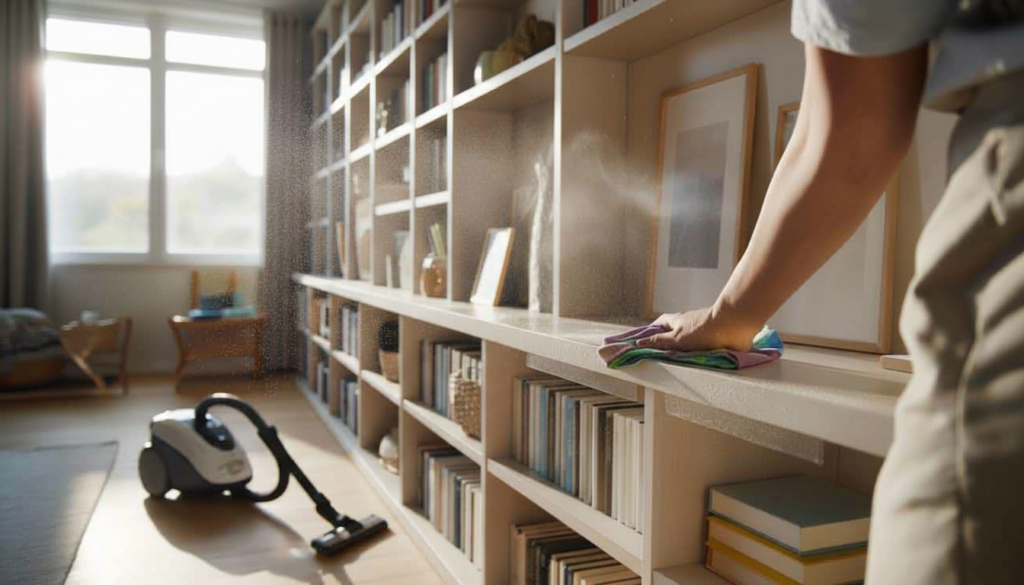
On Sunday, you cleaned the shelves. By Wednesday, a gray film has already formed on your books, picture frames, and little souvenirs you used to love but now hate because they have surfaces. The sunlight coming in through the window doesn’t help either. It just makes every missed corner and every fluffy tumbleweed of dust sliding along the edge stand out.
You run your finger across the shelf and look at the line it makes. You wonder if your house is really dirty or if dust is just winning by default.
There is a quiet story behind that thin veil of gray about the air we breathe, the things we bring home, and how we clean.

You can’t unsee it once you see it.

Why does dust seem to settle on your shelves as soon as you turn your back?
In the morning light, stand in front of any shelf and tilt your head just right. You will see thousands of tiny specks slowly, almost lazily, falling onto your books and other things. That is the enemy. Not the dust you already cleaned up, but the dust that is always in the air.
Our homes are like factories that make soft dust. Skin cells, fabric fibers, little bits of dirt from shoes, pet hair, and pollen that gets in through a cracked window. Everything spins around until gravity does its job and your shelves become the landing strip.
Once you see that it snows all the time, the weekly battle with the duster seems very small.
A family in a small apartment in Manchester says they clean “all the time.” But the shelves in the living room get furry in just three days. Two kids, one dog that loves the couch, and a busy street outside their windows.
Micro-fibers come out of the cushions every time someone sits down. When the kids run by, they kick up what was on the floor. The dog shakes, sending hair flying toward the floating particles. Then a bus goes by, and a little breeze pushes the dust higher into the air.
They thought they were bad at cleaning. In reality, their house was just breathing.
Dust settles more quickly when the air slows down. Shelves are great for that because they are flat, often against a wall, and right at the height where the air flow stops. What about the corners, edges, and those cute trays you bought? They make little windbreaks where particles hit, slow down, and fall.
Some things also work like magnets. Some paints, dry plastic, and some laminates make static electricity. That static draws in dust, holds it a little tighter, and all of a sudden one shelf gets dirty twice as fast as the others.
Once you realize that dust has more to do with air, surfaces, and materials than with how good you are at cleaning, the game changes.
Real steps you can take to slow down dust on your shelve
This is the change that will make a big difference: instead of “dusting” your shelves dry, clean them when they are a little damp. A microfiber cloth that is only a little bit damp picks up dust and holds it, instead of sending it back into the air to fall again in five minutes.
Wipe from the back of the shelf to the front, and then run the cloth along the front edge, where dust likes to build a little fence line. As you move things, give them a quick wipe and then put them back. This way, the decor and the shelf won’t get dusty.
If you want to get a little geeky, you can use a spray that cuts down on static or a tiny bit of diluted fabric softener on the cloth for plastic shelves.
Most of us make the mistake of attacking dust in the wrong order. We lovingly clean the shelves, but the floor underneath them still has a thin layer of dust that is ready to fly away at the slightest step.
Begin at the top and work your way down. Start with the light fixtures, then the tops of the wardrobes, then the highest shelves, then the mid-level surfaces, and finally the floor. That way, anything you move will go into the vacuum or mop instead of back on your newly polished bookcase.
And be nice to yourself. To be honest, no one really does this every day. The goal is not a showroom. “Less dust, for longer.”
When people realize that dust is mostly about habits and air, things change.
“I noticed that I could go almost a week longer between deep cleans after I stopped dry-dusting and started using a cloth that was a little damp. “The shelves didn’t look perfect, but they stopped screaming for attention,” says Laura, who lives in a house from the 1930s where every radiator and window frame seems to collect dust.
Try using a simple mini-routine to help you stick with your new way of doing things:
- Use a damp microfiber cloth to clean shelves, not a feather duster.
- Start with the higher places, then the shelves, and finally the floor.
- Get rid of clutter on surfaces so that dust has fewer places to hide.
- Within 30 minutes of wiping down the shelves, vacuum or mop.
- Do a light cleaning once a week and a deep cleaning less often.
- Little, clever changes that make it take longer for dust to come back
One trick that almost no one talks about is changing how things are arranged on your shelves. Stacks of magazines, complicated decorations with a hundred tiny arms, and fake plants made of dry plastic. They all gather dust in their nooks and crannies and then slowly leak it.
Dust has fewer places to land when you clean up what’s on display. Use closed boxes or baskets for small things, and stand books up and close together. Don’t put a lot of trinkets in a row with an inch between them. You’re cutting the number of surfaces in half, but the shelf still looks full and personal.
Your future self will thank you in silence when you see cleaner shelves next week.
When you deal with the air, not just the surfaces, pay attention to what happens. Your vacuum cleaner should have good filters, and you could also put a basic air purifier in the room with the dustiest shelves. Even just opening the windows for a short time in the cooler hours can help your home “exhale.”

A lot of people use an old vacuum that spits out fine dust from the back. Or they don’t change the filter for months and then wonder why everything looks gray again by Thursday. **A vacuum with a HEPA filter** used slowly along the edges of furniture and along the walls will keep fine dust from getting to your shelves in the first place.
We all know that feeling when you realize your cleaning supplies are working against you.
Rhythm is the last piece of the puzzle. Not perfect, just a realistic rhythm that keeps dust from getting too comfortable.
Karim, who works from home with a lot of tech gear and open storage, says, “If I wait until the shelves look bad, I’ve already lost.” “I do a quick ten-minute pass every Sunday and a longer one once a month.” It sounds like more work, but it feels easier because nothing ever gets gross.
Take a look at your own week:
Where would a “shelf swipe” of 5 to 10 minutes fit in?
Which room annoys you the most when it looks dirty?
This weekend, which shelf could you clean up?
Could you please upgrade just one thing, like the cloth, vacuum, or filter?
Who else in the house could own a small part of the routine?
Living with dust without letting it take over your shelves
It’s a quiet relief to know that dust will always be there. It’s a part of being human to live with pets, plants, and open windows. The goal is not a clean lab. The goal is to have a home where the dust doesn’t yell at you every time you walk by the shelves.
You start to notice little levers you can pull when you go from “I need to clean more” to “I’ll change how dust lands here.” Things that don’t collect as much dust. Storage that keeps it out of sight. A vacuum that works a little better. A small change in how you wipe. **Those little changes are often more important than heroic cleaning days that leave you tired and back to where you started in a week.**
People whose shelves always look clean and dust-free probably don’t have less dust. They just stop it earlier and in a less harsh way. They keep the air moving, the mess down, and the tools working. And they quietly do a few boring, low-effort things over and over again until the problem becomes clear.
In harsh sunlight, your shelves might not look perfect for Instagram. If you really look for it, there might always be a faint film. But when the rhythm kicks in, dust stops feeling like a personal failure and becomes what it really is: something that needs to be cleaned up.
That’s when a shelf becomes a place for your stories again, not a place to fight.
| Key point | Detail | Value for the reader |
|---|---|---|
| Damp microfiber over dry dusters | Traps particles instead of sending them back into the air | Dust returns more slowly, shelves stay clean for longer |
| High-to-low and floor-last routine | Clean top surfaces and shelves before vacuuming or mopping | Reduces resettling, saves time and effort across the week |
| Declutter and manage airflow | Fewer objects, better storage, cleaner filters and gentle ventilation | Less dust produced, less dust landing, calmer-looking shelves |
Questions and Answers :
How often should I clean the shelves so that dust doesn’t build up? Most homes only need a quick wipe down with a damp microfiber cloth once a week. Once a month, they need a deeper clean, which includes moving things around and cleaning higher spots.
What is the best cloth or tool to keep dust from settling again? A slightly damp microfiber cloth works much better than feather dusters or dry rags, which tend to push dust back into the air.
Do air purifiers really get rid of dust on shelves? Yes, especially models with a HEPA filter. These filters catch tiny particles in the air that would otherwise settle on flat surfaces.
Why do some shelves get dusty faster than others? Location, airflow, and the material all matter. Shelves that are close to doors, heaters, windows, or made of plastic that collects dust easily will usually get dusty faster.

Should I get a new vacuum cleaner to fight dust? Upgrading to a vacuum with a sealed system and HEPA filter can help get rid of a lot of dust in your home if your current one is old, doesn’t have a good filter, or smells like dust when you use it.