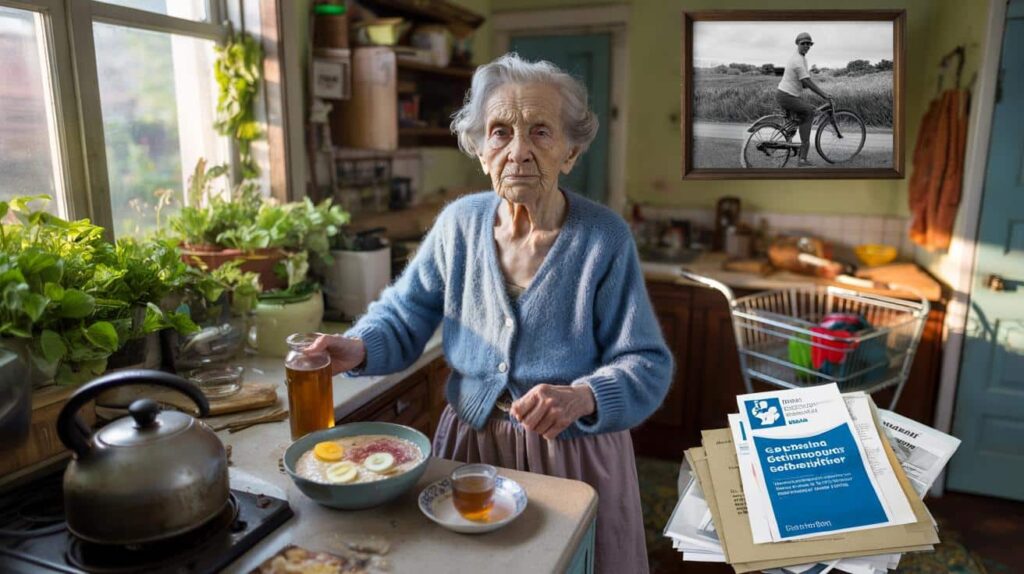
A small brick house on the edge of town has a kettle that whistles at 7:03 a.m. A small woman in a blue cardigan leans on the counter, not a walker, and stirs her tea with the calm precision of someone who has done this about 36,500 times in a row. There is a pile of unopened letters from the local council and her doctor’s office on the table. “Everyone is trying to put me in a home,” she says, pushing them aside to cut up a banana for her porridge. A black-and-white picture of her at 25 riding her bike through the countryside hangs on the wall behind her. Same sharp eyes. The chin is tilted the same way, which says no in a soft but firm way.
Some people get older on the calendar. She seems to collect years like postcards.
She says she’s “100, going on stubborn.”
The 100-year-old who threw the retirement home brochure in the trash
The first thing that surprises you when you walk into Margaret Lewis’s house is how loud it is. The radio is playing, a pot is rattling on the stove and Margaret is humming out of tune as she waters a bunch of plants that are growing around the window. There is no smell of disinfectant, no institutional beige, and no schedule taped to the wall. “Retirement home?” she waves her hand. “That’s for people who have stopped living.” At 100, she lives alone, cooks her own meals, and still won’t wear the emergency call pendant that her daughter tried to sneak onto her keychain. Her doctor has told her to look into “assisted living” twice. Twice she has smiled, nodded, and gone home to make an apple crumble.
Like breadcrumbs, her little acts of rebellion happen all day long. She walks three blocks to the postbox at 9 a.m. instead of going to the clinic for physiotherapy, even if she doesn’t have a letter to send. She jokes, “I post my legs.” She peels potatoes by hand at noon because “machines make people lazy.” Three afternoons a week, she plays cards with neighbours who are half her age and wins often enough to make them look at her funny. The World Health Organization’s most recent data shows that the average life expectancy around the world is about 73 years. She has already done that almost three decades ago, without a personal trainer, an app, or a wellness retreat. She has never kept track of how many steps she takes. She keeps track of how many times she laughs.
If you ask her why she doesn’t like retirement homes, she won’t give you a political speech. She talks about how to keep time. “In those places, they ring a bell and everyone eats. Another bell, and everyone goes to sleep. People stop making choices. She thinks that losing those little choices—like when to get up, what to wear, or whether to have one cookie or three—is worse than missing a doctor’s appointment. She believes that doctors are now the high priests of a new religion based on fear. “They see you as a bunch of problems,” she says, “not as a person who knows herself.” She doesn’t hate medicine. She thinks that her daily routines, her stubbornness to stay in her own kitchen, and the small risks she still takes are what keep her heart beating stronger than any prescription.
The daily routines she swears by (and why she doesn’t trust doctors)
Margaret’s day is made up of small, exact habits that don’t seem like much until you add up a hundred years of doing them over and over. She wakes up on her own, between 6:30 and 7:00, with no alarm clock or sleep app nudging her with graphs. She drinks hot water with a squeeze of lemon “to wake up my insides,” then sits by the window for ten minutes and just watches the light change on the street. Her breakfast is pretty much the same every day: muesli with fruit, a little honey and a piece of toast. No detox smoothie, no hard-to-follow diet. She laughs and says, “I’ve been eating the same things since before half of these diets were even thought of.” One hour of movement spread out over the day: walking, stretching while the kettle boils, and slowly kneeling to cut off dead leaves from her plants.
She also does things to keep her mind and body healthy without calling them that. She calls someone every day around four in the afternoon. A niece. A person who lives next door. The woman who works at the library. The talk can last up to three minutes at times. It can go on until the soup boils over. She says, “If I don’t talk, I rust.” Once a week, she writes a real letter and sends it to someone who doesn’t expect it. There is a pile of reply cards on her living room shelf from people who were shocked to hear from her. For years, research from Harvard’s long-term adult development study has shown that having strong relationships is a better predictor of a long life than cholesterol levels. Margaret doesn’t know the number, but she has built her life around the practice. Her opposition to retirement homes is also an opposition to being alone. She says that if she ever leaves her house, it won’t be to watch TV with other people.
At first, she didn’t trust doctors very much. One person told her to stop hanging heavy laundry because of her back when she was 60. She didn’t listen to him and learned to bend in a different way. Another person told her to stop gardening when she was 75. That summer, her tomatoes were amazing. She was given a mix of pills “to be on the safe side” when she was 88. She looked at the flyer, marched back, and asked which ones she really needed. They cut the list in half. She says, “They mean well.” “But they don’t live in me.” I do. *She makes a clear difference between care and control, and she believes the modern system has gone too far toward the second. For her, everyday habits like eating simple foods, moving around every day, connecting with other people, and being stubbornly independent are more than just things she likes. They are medicine that can’t be changed. You don’t have to wear a white coat.

How she really does it (and what she’d tell you to do to copy her)
When you ask Margaret for her “secret routine,” she laughs so hard that she coughs. Then she gives you some very useful advice: “Give your day a spine.” She means that you should do one anchor in the morning, one in the afternoon, and one in the evening almost without thinking. Making her bed perfectly is the first thing she does every morning. Tight corners, pillowcases that are smooth, and a blanket that is folded just right. She guards it like a ceremony for five minutes. She walks in the afternoon, no matter what, even if it’s raining or her knees hurt. She takes a shorter route when things go wrong. In her notebook, she writes down one thing she noticed, one thing she’s thankful for, and one thing she’s looking forward to tomorrow. That’s all. There is no 27-step miracle routine. Just three things that keep the day from turning into mindless scrolling or TV.
She is the first to say that she hasn’t always been this disciplined. “I wasted years worrying and sitting,” she says. It’s strange that someone so stubborn would give such gentle advice: start small, but start. One stretch while the water boils. One honest talk about whether you really want to drink that second glass of wine every night. One walk around the block without your phone. She rolls her eyes at the thought that you have to keep track of, improve, and improve the improvement. She says, “People don’t need more data.” “They need fewer excuses.” Then she calms down and says that there are still days when she stays in her robe too long, eats cookies for lunch, and doesn’t go out. Let’s be honest: no one really does this every day. The difference is that she doesn’t see those days as a permanent forecast; she sees them as passing clouds.
“Doctors are helpful when something is broken,” she says. “But they’re not gods. You don’t give them everything in your life. You know what you eat, how you feel, and what you stay away from. That’s what you do. Not theirs.
She taps the table with one finger and counts the things she trusts more than a prescription pad:
- She cooks her own meals, even simple ones, so she knows what’s in them.
- She walks every day, not to keep track of her fitness, but to stay aware of her own strength.
- Staying in her own home as long as it’s safe, with her own things around her
- Talking to people of different ages so her world doesn’t get smaller
- She questions any pill, test, or “routine” that doesn’t make sense to her. She doesn’t deny that a good GP is important. She just thinks that too many of us give up the little choices that slowly improve or hurt our health long before a doctor comes in.
A hundred years of being stubborn that makes people ask hard questions
When you spend a day with Margaret, it’s like being in a quiet argument about how we’ve been taught to get older. She doesn’t mind getting help. She has a neighbour who checks on her after heavy storms and a cleaner who comes twice a month. She knows that one fall could change everything. She doesn’t agree with the idea that turning 80, 90, or 100 means giving the keys to your life to people in uniforms. You can feel the tension as she shuffles to the bus stop with her shopping cart. She is torn between safety and freedom, medical advice and her own gut feeling, and the question of what those extra years are for.
Not everyone will be able to relate to her story. Not everyone can or should live alone at 100. But her daily choices make us wonder if we’ve given up too much of our health and dignity to systems that see us more as patients than as people.
| Key point | Detail | Value for the reader |
|---|---|---|
| Daily anchors | Simple, repeatable habits morning, afternoon and evening | Offers an easy structure to feel less passive and more in charge of your day |
| Questioning authority | Asking why for each pill, test or recommendation | Encourages informed decisions instead of blind obedience to medical advice |
| Protecting autonomy | Staying involved in cooking, movement and social ties | Shows practical ways to maintain independence longer and delay institutional care |