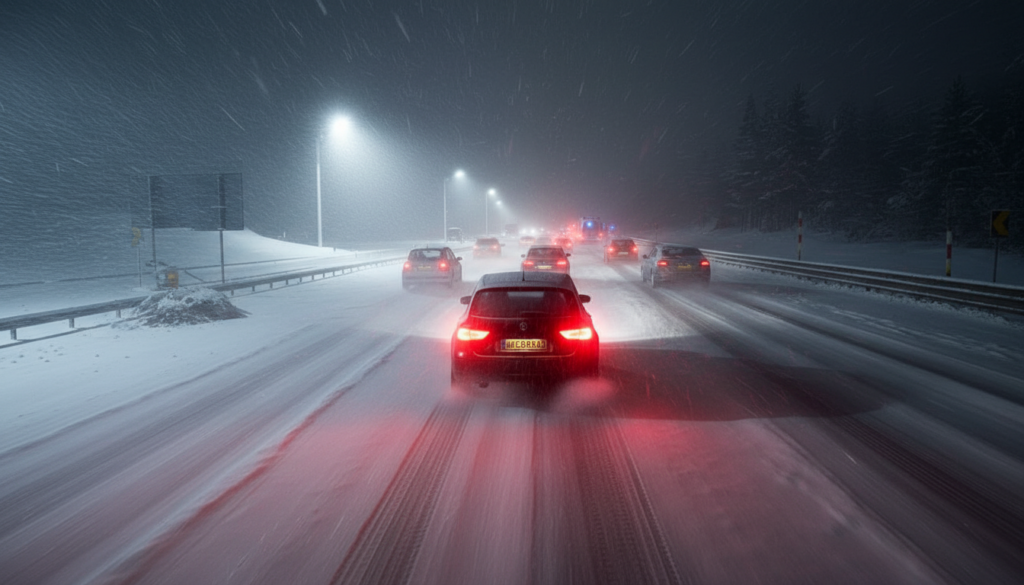
The first flakes begin falling just after rush hour, soft and almost beautiful, the kind that tempts drivers to film the sky through a foggy windshield. Then the alert flashes across phones: heavy snow warning, visibility expected to collapse tonight. Inside the car, the heater hums, music plays, and the navigation system confidently promises an arrival time that already feels unrealistic. On the radio, the same calm message repeats: “Travel only if your journey is essential.” Still, out on the motorway, red brake lights stretch into the distance like a glowing river flowing straight into uncertainty.
When an Ordinary Road Becomes a Gamble
There’s a strange confidence that surfaces when the weather turns dangerous. The same drivers who slow down for light rain suddenly believe a three-hour journey through a whiteout is manageable. “It’ll be fine,” they say. “We’ve handled worse.” The highway transforms from routine infrastructure into something closer to roulette.
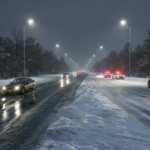
Gradually, the sky tightens around the road. Headlights reflect off thickening snow and bounce straight back into tired eyes. Lane markings disappear beneath slush. The world narrows to a flickering white tunnel. Last winter, police reported repeated scenes: urgent weather warnings, advice to delay travel, and yet long lines of vehicles still crawling into blizzards.

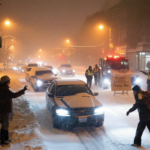
In one clip filmed from a snowplow, cars edged around stranded trucks, squeezing along barely visible shoulders. Some carried children in the back seat. Others towed small trailers swaying in icy wind. Hours later, that same motorway resembled what officers described as “a frozen parking lot,” engines idling, fuel draining, tempers rising in the cold.

Why do sensible people take that chance? Part optimism, part pressure. We assume we’ll be the careful exception. We don’t want to cancel plans, disappoint family, or waste money. And we underestimate how quickly conditions shift. One moment visibility stretches ahead. Minutes later, it collapses to a handful of metres.
Deciding If the Journey Truly Matters
Before picking up your keys, ask a harder question: “If I’m trapped for six hours in a freezing traffic jam, is this still worth it?” Say it out loud. That question slices through excuses faster than any weather app.
If the answer feels uncertain, that uncertainty is information. Shift the focus from “How do I get there?” to “How do I postpone?” Make the call. Reschedule. Accept the inconvenience. Decisions are easiest in your hallway; they are nearly impossible once you’re boxed in between lorries on an icy motorway.
Many drivers promise themselves they will turn back if things worsen. But once traffic thickens and visibility vanishes, turning around is no longer an option. You are committed to a choice made an hour earlier on your sofa.
There’s also pride involved. Nobody wants to be seen as overcautious. Yet the embarrassment of cancelling rarely compares to the stress of hazard lights blinking in a blizzard. As one highway patrol officer admitted, “Most people we rescue had multiple chances to stay home. They just didn’t take them.”
Check forecasts twice. Redefine what “essential” truly means. Set a clear no-go threshold before the snow begins. Create backup plans so you don’t feel cornered into driving.
The Hidden Cost of Treating Storms as Background Noise
Snow driving is often framed as a test of skill. But the danger extends beyond one vehicle. A single unnecessary trip can ripple outward: forcing others to brake harder, blocking emergency lanes, slowing ambulances, trapping snowplows behind stranded cars.
Most of us drive in heavy snow only a few times a year. We are not seasoned Arctic professionals. When visibility collapses under headlights, depth perception fades. Speed becomes guesswork. Some drivers crawl, others maintain old habits, and that difference creates sudden chain reactions. One abrupt brake. One slight skid. Suddenly, a dozen vehicles are involved in a scene none of them predicted.
That moment when the world outside the windscreen turns into a swirling wall is unforgettable. It reveals how small our control really is compared to weather.
So the better question isn’t “Can I manage this?” but “Do I need to attempt it at all?” There is no reward for arriving shaken and exhausted. Only relief that luck held.
When the Warning Stops Being Theoretical
At some point this winter, the snow will fall harder than expected. Alerts will repeat across our screens, and the same internal debate will surface: “Maybe it won’t be that bad.” That quiet argument is where outcomes are decided, long before any accident report or viral footage.
If we treated severe weather with the seriousness we give to cancelled flights or medical appointments, much chaos would quietly disappear. Fewer cars create safer roads for those who genuinely must travel—nurses, repair crews, emergency responders.
The next time a forecast says visibility could drop “within minutes,” picture what that actually looks like. Imagine the shrinking space between bumpers, the uncertainty in other drivers’ eyes, the way the world narrows to almost nothing. Sometimes the strongest decision is also the simplest one: staying exactly where you are.
| Key point | Detail | Value for the reader |
|---|---|---|
| Snow can turn lethal in minutes | Visibility can drop from clear to near-zero faster than journey apps can update | Helps you respect how quickly conditions can outpace your plans |
| Most trips are not truly essential | Social plans and non-urgent travel rarely justify long drives in blizzards | Gives you permission to cancel without guilt when roads become dangerous |
| Your choice affects others | Reckless long-distance journeys block emergency services and snowplows | Encourages decisions that protect not just you, but everyone sharing the road |