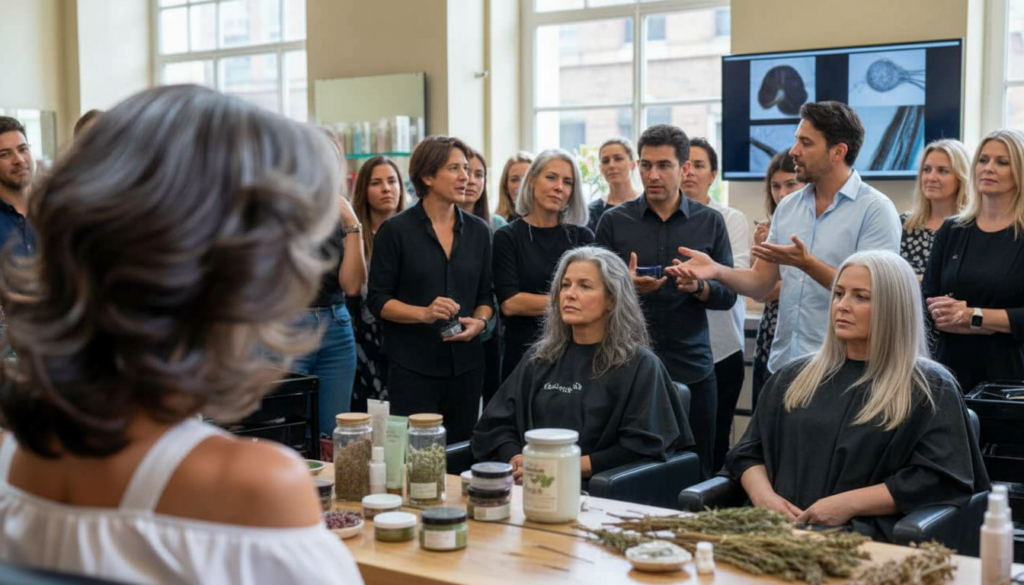
On a busy Tuesday morning inside a packed Madrid salon, a woman in her early fifties studies her reflection while a young stylist twists a strand of her silver hair between his fingers. Around them, bowls of dye, foils, brushes, and gloves are lined up like tools for a transformation. The air smells faintly of ammonia. Dryers roar. Clients compare prices.
But she pauses. On her phone, an Instagram reel is frozen on a confident gray-haired influencer saying, “No dye, no shame — and I’ve never looked better.”
From Habit to Rebellion: Why Gray Is Being Reimagined
For years, covering gray roots was almost automatic. Like renewing a subscription or paying a bill, it wasn’t questioned — it was scheduled. Gray hair symbolized “giving up,” and salons quietly thrived on that fear of visible aging.

Now the narrative is bending. Social feeds are filled with women in their 30s, 40s, and 50s proudly showing natural silver streaks. Captions read “my authentic shade” and “aging without apology.” The appeal isn’t just aesthetic — it’s emotional. Fewer harsh chemicals. Fewer emergency touch-ups. A softer glow around the face.

Stylists in cities like Paris and Barcelona report a noticeable change. Clients no longer arrive with celebrity color references. Instead, they show selfies taken in natural light. “Keep this silver here,” they say. “Blend this part.” The goal isn’t to look younger at any cost. It’s to look real — but refined.
On TikTok and Instagram, tags like #grombre chronicle long transitions from dyed brunette to natural gray. Some document the awkward in-between months — visible lines, uneven growth, moments of doubt. Others choose softer transitions: subtle lowlights, toning glosses, strategic blending.
Market data echoes the shift. In several countries, permanent dye sales have plateaued while gray-enhancing shampoos and shine treatments are rising. The message isn’t anti-beauty. It’s anti-panic.
The Rise of “Natural” Gray Hacks — And Their Hidden Risks
Embracing gray doesn’t always mean doing nothing. In fact, many professionals argue it requires more strategy, not less. The first change is often the haircut. Structured layers, shorter lengths, or a soft fringe can make silver strands look intentional rather than accidental.
Then come the subtle adjustments. Semi-permanent toners to neutralize yellow tones. Clear glosses for added shine. Plant-based stains applied only to the ends. These methods don’t shout transformation — they whisper enhancement.

At home, experiments multiply. Henna blends. Coffee rinses. Rosemary oil massages. Chamomile sprays. Online forums read like recipe exchanges. Some women swear their hair darkens slightly with herbal treatments. Others mix cocoa powder into conditioner to “soften” regrowth.
Results vary wildly. Sometimes the effect is charming. Sometimes uneven. Occasionally disastrous. Dermatologists warn that “natural” doesn’t guarantee safety. Essential oils can irritate the scalp. Henna may trigger allergies. Homemade blends can dry out already fragile gray strands.
Stylists often spend hours correcting online experiments that promised miracles in seconds. The fantasy of zero maintenance is exactly that — a fantasy. Gray hair still needs care. Just a different kind.
Hide, Blend, or Highlight? The Real Question Behind the Trend
Underneath the aesthetics lies something more personal: identity. That first white strand spotted under bathroom lighting can spark emotion. Some pluck it immediately. Others reach for a dye box. A growing number choose to pause and let it stay.
Yet the social tension remains. A professional woman may feel confident with silver streaks among friends but hesitate before a high-stakes presentation. A parent might feel empowered — until someone casually comments on looking “older.” The mirror becomes a negotiation space between freedom and fear.
Experts suggest clarity before action. Do you want to completely hide gray? Blend it softly? Or highlight it intentionally? Small steps — glosses, partial coverage, consultation photos in natural daylight — can prevent regret. Patch-testing any new product protects scalp health.

The gray conversation is no longer about surrender. It’s about choice. And that choice looks different for everyone standing in front of the mirror.

| Key point | Detail | Value for the reader |
|---|---|---|
| Gray can soften features | Well‑cut, shiny silver reflects light and brightens the face | Helps you see gray as a styling asset, not just a sign of aging |
| “Natural” still needs a plan | Cut, contrast, toners and scalp care matter as much as color | Guides you toward realistic, low‑risk choices instead of viral miracles |
| The emotional side is real | Social pressure, work context and self‑image all weigh on your choice | Reassures you that doubts and mixed feelings are normal and shared |