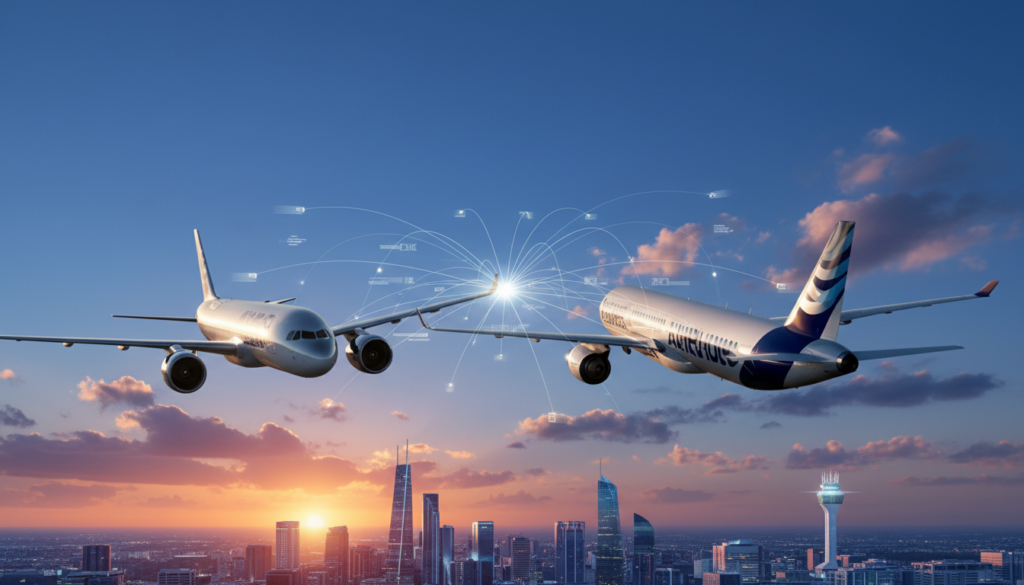
A queue of engineers stands still on the edge of a dusty runway in southern France, staring at two white shapes in the sky. The Airbus test center is bathed in a soft orange light from the late afternoon sun, but no one notices. In the control room, people are hovering over keyboards, radios are making soft noises, and a big screen shows two small icons moving toward the same point in space.
Nobody says anything.
That little point has been a red line for years, and it was never meant to be crossed by flight paths. They do now.
Two planes, one handshake that can’t be seen.

The day Airbus came close to doing the impossible
It almost looks wrong on the radar. Two blips sliding together on a collision course, coming together at a shared point like magnets. The control room near Toulouse is very quiet, which is strange because the voices on the radio are calm and measured.

A few veterans stand on the tarmac with their arms crossed, going over decades’ worth of flight rules in their heads. Every lesson that pilots have learned since the beginning of commercial aviation has the same message: planes do not meet. They stay away from each other, go in different directions, and split up.
But that day, Airbus chose to change that unwritten rule.
When you say it out loud, the experiment sounds crazy. Two test planes fly toward the same virtual point in the sky at the same time, without touching or putting themselves in danger, as if they were on an invisible rail. No last-minute braking, and no human reflexes to save the day. Only math, sensors, and code.
For months, the team ran thousands of scenarios through simulations. Wind shear, turbulence, pilot reaction time, and instrument drift were all sent to powerful computers until the pattern was so clear it was almost boring. But every safety engineer secretly wants to be bored.
The big question then came up: do we have enough faith in the system to try it for real?
There is a simple, almost brutal logic behind this mission. Airports are full to the brim, and the old way of keeping planes “comfortably apart” is no longer working. You can’t stretch the sky any more than that.
Engineers are in a strange situation where they have to keep aviation growing without making runways into stress zones. To make flying safer, cleaner, and more predictable, they need to bring planes closer together. That means order, not chaos. Algorithms that can communicate faster than people can.
That day, Airbus didn’t just flirt with danger; they tamed it so well that it ran out of room.
How do you get two planes to the same place without causing a disaster?
“Precision” is the magic word in the hangars. Not the kind that isn’t clear. Real meters and milliseconds. The engineers made what they call a “merge point,” which is a virtual place in the sky where planes can meet, just like cars can meet at the right time at a junction.
Not only does each plane know where it is, but it also knows where it will be in the next few seconds and minutes. Data is always moving between the cockpit, the ground, and satellites. The speeds are changed by small amounts, and the headings are changed by small amounts, like a DJ changing the tempo just enough to make two songs fit perfectly on the same beat.
It doesn’t feel heroic from the pilot’s seat. It feels… oddly smooth.
Think about what happens at a busy roundabout during rush hour. Cars slide in, merge, and leave with just a few inches to spare. From above, it looks like a mess, but most days, everyone goes through. Now picture that same flow, but every driver can see the whole roundabout from above and knows exactly when to get on. That’s about what Airbus is making in the air.
The first test had two Airbus planes coming from different directions to the same point, with a small difference in height and time. The icons almost perfectly overlapped on the big screen. The crews saw each other glide past with clinical grace through the window.
The pilots on the radio sounded almost calm. No one was behind the glass.
This kind of operation, which engineers call “trajectory-based” or “time-based,” could change the way planes line up and land in a big way. Today, a lot of safety comes from buffers, which are long, thick cushions of time and space. They do work, but they use up gas and time.
The system cuts down on holding patterns, delays and kerosene use by making planes move like a dance instead of a scramble. Less noise over cities, fewer go-arounds, and more reliable arrival times. *We all know what it’s like to be on a plane that circles the airport for hours and no one really explains why.

The truth is that the sky has been safe for a long time, but not always smart.
What this means for you, even if you never touch a cockpit
You can turn the method behind this “impossible” meeting into something very real: trust the hidden layers of planning. Airbus teams practiced every part of the manoeuvre so many times before the test that it felt almost boring. That’s a lesson about life that you don’t have to say out loud.
When we see something amazing, like two planes sharing a point in space, we forget all the time we spent tweaking, simulating, and running drills. The engineers broke the mission down into manageable parts: figure out where to merge, measure all the variables, practise the flows, and then fly.
You can use the same way of thinking for hard tasks in your own life. Make the scary thing smaller by breaking it down into small steps. Let the preparation do the work.
There is a human side to all of this maths. Pilots joked that their job was becoming “flying on rails,” but none of them wanted to give up control. Engineers had to be very careful: automation that anticipates, not automation that takes over. Anyone who has ever trusted GPS but still looked at road signs just in case knows that feeling.
You’re not the only one who feels uneasy about planes flying closer together. We are wired to be afraid of being close to danger, even if it is only a small chance. Let’s be honest: no one really reads aviation safety reports before they book a flight. We just want to know that someone, somewhere, is paying close attention to the details.
In this case, that obsession shows up as layers. Technology, processes, and people in charge are all stacked up so that one of them never takes on all the risk.
One Airbus test engineer told me, leaning against a whiteboard still covered in equations, “From the outside, it looks like we’re tempting fate.” “The whole point is to take fate out of the picture from the inside.”
Safety in layers
There are many systems that keep track of position, timing, and separation, so one mistake doesn’t cause a disaster.
Coordination in real time
Aircraft and ground systems share data all the time, so there is no more guesswork.
Arrivals that are easy to guess
When planes arrive on time and in a steady stream, delays go down, fuel use goes down, and stress in the cabin and cockpit goes down.
Still in the loop with people
By design, pilots can step in, override, or leave the manoeuvre at any time. This is not a last resort.
Quiet benefits on the ground
Less holding in the air means less noise over cities and more stable travel times for people.
Our sense of risk needs to catch up when the sky gets smarter.
The technical accomplishment from that day in Toulouse isn’t the only thing that stays with me; it’s also the strange feeling in the room afterward. Slowly, the tension went away and was replaced by a mix of pride and disbelief. The two planes had done what pilots had been told for generations not to do. And still, no alarms, no sharp turns, and no fear. Just a clean crossing of paths, like a habndshake at the right time.
This is where the story goes beyond flying. Every time you take a risk to improve safety, it tends to follow the same curve. People used to be afraid of getting stuck in a box, so the lift needed a person to run it. When you stepped on the brakes of a car with ABS, it felt strange. We hardly think about either one now.
Airbus’s test suggests that the car ride to the airport might be the most dangerous part of a trip in the future. But to accept that future, you need to change the way you think. We still think of the sky as a big, empty space where planes stay out of each other’s way. In reality, it’s slowly becoming a dynamic network where distance is measured exactly, not just avoided.
There will be some awkward conversations because of that change. Some people who travel will feel better knowing that the skies are smarter. No matter how many charts you show them, some people will get tense when they hear “planes closer together.” Fear doesn’t always think about safety margins.
The most honest way to look at it is that progress in aviation is not usually about making things more exciting. It’s about getting rid of doubt. The test in France wasn’t just for show. It was just one more step in a long, stubborn effort to make flights smoother, more predictable, and less wasteful.
Next time your plane lands without circling and slides right into its slot, as if the runway had been waiting just for you, some of this invisible choreography might be at work. Two planes, one point in space, and no crash. This is a quiet revolution that you probably won’t see from your window seat.
It will just feel like the trip went strangely, but in a good way.

| Key point | Detail | Value for the reader |
|---|---|---|
| Smarter use of airspace | Airbus synchronizes aircraft to pass through shared merge points safely | Clearer picture of how future flights can be faster and less stressful |
| Layered safety approach | Multiple systems, simulations, and human oversight back every maneuver | Reassurance that “closer” in the sky can still mean “safer” overall |
| Real‑world benefits | Fewer holding patterns, lower fuel burn, reduced noise over cities | More on‑time arrivals, smoother trips, and a smaller environmental footprint |