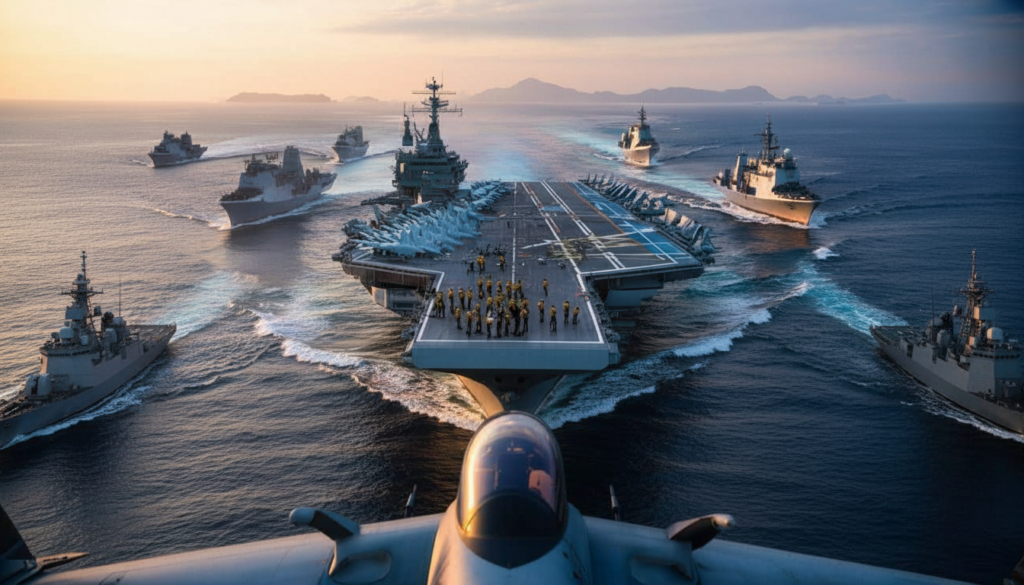
In a quiet operations room on Japan’s Pacific coast, the radar screens started to light up just after dawn. Coffee cups shook near keyboards as a familiar but unsettling shape appeared on grainy monitors: a long, flat deck, an escort of warships, and a digital tag that made some officers lean in closer. Liaoning. The first aircraft carrier in China. Moving slowly but steadily along the edge of Japan’s defensive bubble.
Most of the country was waking up to school runs, crowded trains, and breakfasts at convenience stores. People at the Defence Ministry were already writing press releases and checking satellite feeds, carefully choosing each word.
It was a “observation” mission on paper.

It felt like a warning in the room.

Japan sees the Liaoning right outside its door.
The Japanese Defence Ministry says that its Maritime Self-defence Force saw the Chinese aircraft carrier Liaoning and other ships sailing near Japan’s southwestern islands. The group is said to have travelled through the waters between Okinawa and Miyako, a narrow but important passage that has quietly become one of Asia’s most dangerous sea lanes.
This route is starting to feel like a normal part of life for radar operators and analysts, like when a neighbour walks by your front gate a little too slowly. Not against the law. Not really friendly, either.
There is a tingling question in the air after every passage.
The sighting from last week looked like a small ritual that Japan is now very familiar with. Maritime patrol planes were sent out to follow the Chinese fleet. A destroyer followed the carrier from a safe distance, keeping track of every change in speed, heading, and activity on the flight deck.
From the air, the Liaoning looked busy, with fighter jets and helicopters taking off and landing and deck crews moving in a practiced way that showed they were getting better at what they were doing. Japan’s cameras and sensors got a lot of useful information from it. For fishermen in the area, it was just one more reason to nervously look at the horizon.
We’ve all been in that situation when something that is technically okay starts to feel like it is crossing an invisible line.
The Chinese task group was working in international waters on a map. This was outside of Japan’s territorial sea but well within what Tokyo calls its “security concern” zone. That legal grey area has become the main stage for a long, slow theatre of signalling. Beijing uses the Liaoning and its escorts to practise showing off its military power and to show its people a navy that is getting stronger.
Tokyo responds with public announcements, photos, and maps to remind both Japanese citizens and allies that “its watchkeepers are awake.” The pattern stays the same: China sails, Japan watches, headlines from around the world come out, and a quiet battle of nerves goes on. *No missiles are fired, and no shots are fired, but everyone’s hand is a little closer to the alarm.
Why this “routine” sighting seems different
People who live on Japan’s remote islands, where Chinese and Japanese ships sometimes sail in the same stretch of blue, now know what the name Liaoning means. This isn’t just another grey ship on the horizon. It floats as a sign of how far China’s navy has come and how close it is willing to go.
The Japanese Defence Ministry said that the most recent sighting was part of a “series of activities” by the Chinese military near Japan’s territory. That phrase, “bureaucratic on paper,” includes a lot of real things that are getting bigger, like drones, bombers, patrol ships, and survey vessels. The Liaoning is just the most obvious guest in a crowd that keeps coming back.
A few years ago, seeing the Liaoning near Japan made the front page of the news. The carrier’s presence is still making headlines today, but the tone has changed from surprise to pattern recognition. Data from Tokyo’s announcements show that Chinese carrier groups, like the Liaoning, have been using Japan’s surrounding seas as regular training grounds. Sometimes, they even circle the archipelago in complicated drills.

Each loop gives Chinese pilots a chance to practise taking off and landing in rough seas. Every escort mission helps Chinese captains get better at sailing in formation and planning long-distance trips. For Japan, this is bad news: every day of training for the Liaoning makes a possible enemy better at what they do. Let’s be honest: no one really does this every day just to show off.
The corridor between Okinawa and Miyako is a narrow gate between the East China Sea and the wider Pacific. When the Liaoning passes through, it’s not only sailing near Japan; it’s rehearsing how to break out of what Chinese strategists sometimes call the “first island chain” – the arc of U.S.-aligned territories that currently constrains China’s navy.
From Tokyo’s point of view, it would be unthinkable to let this go without being watched. That’s why JMSDF destroyers and P-3 or P-1 patrol planes stick like shadows to the Chinese flotilla, showing the flag while quietly collecting radar signatures, engine noise patterns, and images of every aircraft on deck. **China gets training. Japan gets information. The rest of the area has more reasons to be worried.**
What Japan does when the Liaoning comes
Behind every crisp press release about “confirming the movements” of the Liaoning, there’s a concrete, almost choreographed response plan. Japan keeps a ring of early-warning radars, coastal surveillance units, and patrol aircraft poised around its southwestern islands. The moment a large Chinese formation is spotted entering key chokepoints, a playbook opens.
One ship is assigned to shadow the carrier at a cautious distance. Another might position itself on a possible exit route. Pilots are briefed on the Chinese formation’s usual patterns. The aim is simple: stay close enough to see everything, far enough to avoid accidents, and calm enough to show this is routine work, not panic.
The emotional trap, both for officials and the public, is to swing wildly between complacency and outrage. Either you shrug and say, “It’s just training,” or you go straight to “This means war.” The truth usually sits in between. Japan’s Self-Defense Forces are trained to treat every sighting like a serious professional task, but also to remember that one wrong intercept or one risky fly-by could escalate tension overnight.
Many Japanese officials quietly admit that fatigue is real. Watching similar Chinese maneuvers month after month can numb your sense of urgency. Yet each time the Liaoning appears, there’s a fresh round of domestic debate: Should Japan boost its defense budget faster? Should it buy more long-range missiles? Ordinary people end up reading those questions over breakfast.
Japan’s Defense Minister described the latest Liaoning sighting as “a matter of strong concern,” stressing that the Self-Defense Forces would “continue to conduct vigilant surveillance and information gathering.” The words were measured, but the subtext was clear: this dance is not going away.
- Stay alert to the pattern, not just the incident
One Liaoning passage is a story. A series of them is a strategy. Watching the trend helps you understand where the region is heading. - Separate legality from stability
China sailing in international waters is legal. The way it trains and signals near disputed zones touches regional stability. Both can be true at once. - Notice who responds, and how
Japan’s announcements are aimed at citizens, allies, and Beijing at the same time. The tone of those statements is a quiet barometer of tension. - Remember the human layer
Behind every carrier sighting are sailors away from home, island residents scanning the horizon, and planners sleep-deprived from night shifts. - Ask what “normal” is becoming
The more often carriers appear near Japan, the more they shape a new baseline. That shift in what feels normal is part of the story too.
What this means for anyone watching from afar
From a distance, these updates can start to blur: another Chinese ship, another Japanese statement, another map with arrows over blue water. Yet each time the Liaoning sails near Japan, the region’s future is being rehearsed in slow motion. The crews on deck are training not in theory, but in the exact waters where any real crisis would likely unfold.
For readers far from Okinawa or Miyako, this isn’t just “their problem over there.” Energy routes, shipping lanes, supply chains – they all pass through these contested seas. A more confident Chinese navy and a more vocal, better-armed Japan mean the balance of risk around those routes is shifting. That shift eventually touches fuel prices, trade flows, and even how allied forces move around the globe.
There’s also a quieter question sitting behind every radar track of the Liaoning: how much signaling can a region absorb before someone misreads the message? Japan broadcasts its concerns to show resolve. China sends its carrier to show strength and normality. The United States and other partners read these moves as signals about deterrence and credibility.
Each actor thinks it is being clear. Each audience hears something slightly different. Somewhere between those crossed lines sits the chance of miscalculation – not from grand strategy, but from a bad day, a risky maneuver, a pilot who flies just a bit too close. The Liaoning’s silhouette on a Japanese radar is a reminder that peace, in this corner of the world, now depends on how well everyone manages to live with constant, noisy proximity.

| Key point | Detail | Value for the reader |
|---|---|---|
| Liaoning’s presence near Japan | Chinese carrier group sailed through key waters between Okinawa and Miyako, under close Japanese monitoring | Helps you grasp why this specific route keeps appearing in headlines |
| Routine that isn’t routine | Repeated sightings form a pattern of training and signaling by China, and public messaging by Japan | Shows how “normal” military activity can still raise real strategic stakes |
| Impact beyond the region | Movements affect sea-lane security, alliances, and the risk of miscalculation | Connects an apparently distant naval story to everyday economic and political stability |
FAQ:
Is the Liaoning allowed to sail near Japan?Yes. As long as it stays in international waters, the Chinese carrier group is operating within international law. The tension comes from where and how often it trains, not from the basic right to navigate.
Did Japan confront or block the Liaoning?No. Japanese forces shadowed and monitored the group, taking photos and tracking movements, but did not attempt to block its passage or interfere with its operations.
Does this mean a conflict is close?Not automatically. These sightings are part of a long-term pattern of military signaling and training. They do increase the risk if an accident or misjudgment occurs, but they are not, by themselves, acts of war.
Why does Japan publicize these movements?Tokyo wants to inform its own citizens, reassure allies that it’s watching the region closely, and signal to Beijing that its activities are being recorded and analyzed.
How does this affect people outside Asia?Stability around Japan and the East China Sea shapes global trade routes, energy flows, and defense planning. What happens near those islands can ripple out into prices, supply chains, and security debates worldwide.