The question seems easy, like a yes-or-no question. But figuring out if women could compete in the ancient Olympic Games means looking at law codes, myths, and some brave rebels who tried to break the rules.
The ancient Olympic Games were only for men
In the 8th century BCE, the Olympic Games started in Olympia as a religious festival to honour Zeus. They weren’t just games. They were a mix of sports, politics, and religion, where city-states showed how strong they were.
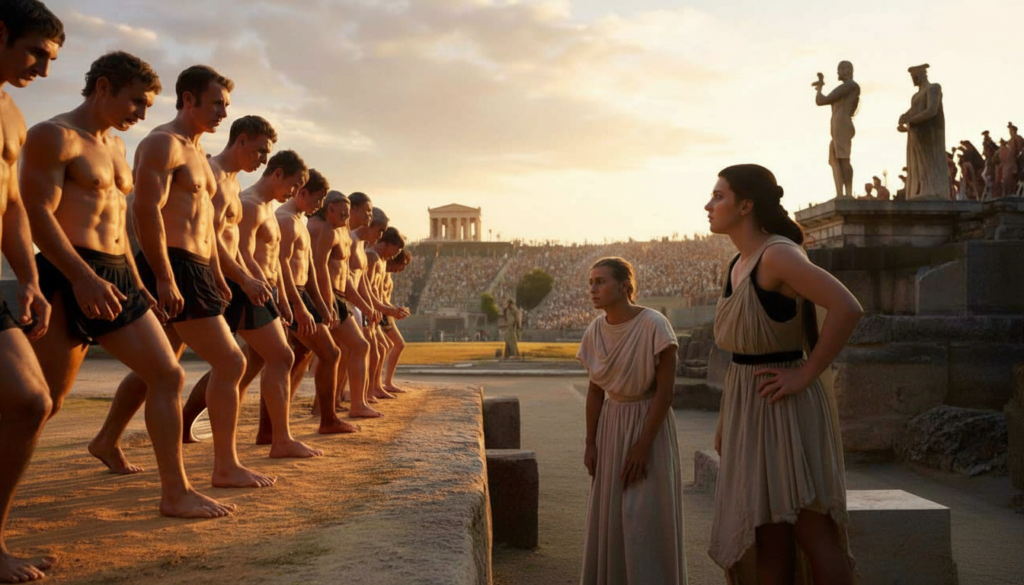
There were strict rules about who could take part. Only Greek men who were not slaves could compete. People who were slaves or foreigners were out. Women had to deal with the hardest barrier of all.

In the old Olympic Games in Olympia, women were usually not allowed to compete or even watch.

The main events were foot races, wrestling, boxing, chariot races, and the brutal pankration, which is a fight sport with no rules. All of the official winners listed in the ancient Olympic victor lists are men.
So, could women even go
There were different rules in different cities and times, but the evidence from Olympia is clear. Women who were married were not allowed to be in the sanctuary or at the Games. The event was set up so that only men could compete and watch.
Some ancient texts even talk about punishments for women who broke this rule. One story says that a married woman who dared to slip in could be thrown off a cliff on Mount Typaeum.
The harshness of the punishments shows how worried Greek men were about keeping this important and religious event only for men.
Even so, unmarried young women may have had some freedom to watch in certain times, especially if they lived close by. There isn’t a lot of evidence. There was no one Greek law code, and different sanctuaries could have different rules.
Why were women not allowed behind the ban
The way ancient Greeks thought about women was different in each city-state, but they all had some things in common. Men were in charge of public life, which included politics, war, and formal sports. Women were connected to the home, having children, and religious roles in the community.
Some reasons that led to the ban are
Nudity in sports: Men played naked, which made the organisers want to keep married women out of the stadium.
Religion and rules about purity: The Games were a celebration for Zeus that had certain religious practices that kept women from being there.
Control of reputation: Good women were told to stay away from public places with a lot of men, noise, and competition.
Politics and citizenship: Sports were linked to war and civic identity, both of which were legally male areas.
These rules didn’t mean that Greek women were weak, didn’t like sports, or were always inside. They just show where the line was officially drawn in Olympia.
The loophole: women can own winning chariots
There was one very strange exception. In chariot racing, the official winner of the Olympics was not the driver, but the person who owned the horses and team. That technicality let rich women say they won the Olympics without ever stepping on the track.
Cynisca of Sparta was the first known woman to win an Olympic event. She owned the team that won the four-horse chariot race.
Cynisca’s success in the 4th century BCE was due to politics. Sparta used her victory to brag that its women were tough and had more rights than men. Later inscriptions praise her success and show that some women could use their family’s power and money to get into a space that men controlled.
Other women, such as later Hellenistic queens, also seem to own winning teams. Still, these kinds of cases were rare and only happened to the richest people.
The Heraia was a game for girls and women
Women couldn’t compete in the main Olympics for Zeus, but they did have their own festival at Olympia called the Heraia, which was for the goddess Hera. This event gave girls a chance to run in a famous sanctuary in front of other people.
Event, Patron God, Who competed, Where
The Olympic GamesZeus: Greek men and boysOlympia
Heraia HeraOlympia Girls and Young Women
At the Heraia, athletes ran a shorter version of the main stadium track. They competed in groups based on their age. They wore short tunics that were cut above the knee and had one shoulder bare. It was a sport that started as a ritual, combining athletic movement with religious duties.

Winners got olive crowns and could have their names carved into them. This was similar to the male Olympic honours, but on a smaller scale. This event shows that ancient Greeks were okay with women being active, as long as it was within religious and gendered limits.
What sports could Greek women really do
Women did different kinds of physical training outside of Olympia, and where they lived had a big impact on what they did.
Sparta’s strange way of doing things
Sparta is different. From a young age, Spartan girls trained their bodies by running, throwing, and wrestling. They said that strong women would have strong sons, so getting women in shape was good for the military.
People from other Greek states were often surprised by how confident and visible Spartan women were. They couldn’t fight in battle yet, but they were much more active than the Athenians.
Athens and other places
Women’s sports were more private in Athens and often had to do with religious ceremonies. Girls might dance in parades, do coordinated movements at festivals, or train lightly in the courtyard of the house.
Women are shown running, dancing, and even lifting small weights in vase paintings and inscriptions. These scenes remind us that men weren’t the only ones who could work out, even if the Olympic Games were.
Legends, myths, and a woman who didn’t follow the rules
Old stories suggest that women tried to break the rules and sometimes did. One interesting story is about Kallipateira, a widow from Rhodes whose male relatives were all athletes.
Legend has it that Kallipateira dressed up as a man to watch her son compete and win at Olympia.
Her disguise didn’t work when she jumped over a barrier in excitement. Officials found out that she was a woman. They were impressed by her family’s athletic record, so they didn’t punish her but made the rules stricter. From then on, trainers had to be naked to show that they were men.
This story, whether it is true or not, shows how tense it was for women to be at a festival that was supposed to be a test of “ideal” male virtues.
How historians put the pieces together
To figure out what women’s status was at the Games, modern scholars use a variety of sources. No one ancient text clearly lays out all the rules, so we have to compare them carefully to find the answer to our headline question.
Pindar, Pausanias, and other writers talk about Olympic winners, festivals, and strange cases like Cynisca.
Inscriptions: Stone records show who won and who dedicated things, and sometimes they even name female horse owners.
Archaeology: The layout of the stadium, the altars, and the statues show who was honoured and where people might have stood.
Art: Vases and reliefs show clothing, races, and processions, which can help us understand gender roles.
This collection of evidence leads to one conclusion: women could not stand on the starting line at the Olympic Games, but they could take part in related rituals, separate festivals, or as financial backers of winning teams.
From a modern stadium seat, reading about the ancient Olympics
For people who are watching women compete in the Olympics today, the old rules may seem far away. But the echoes are still there. There have been arguments about who can compete, what counts as “acceptable” female strength, and how bodies are controlled in sports long before the 21st century.
Teachers and sports coaches sometimes use ancient Greece as an example of how rules are made not just by how well someone plays sports, but also by deeper fears about gender, religion, and power. Asking if women could compete in the first Olympics gives us a look at those old fears.

For students, a simple classroom activity makes this clear: picture making a new “ancient-style” rulebook for a modern school sports day, with rules like those at Olympia. Who would be able to run? Who could see? What justifications would be provided? When you compare that imagined system to today’s inclusive policies, you can see how much sport has changed and what questions still need to be answered about access, fairness, and visibility.