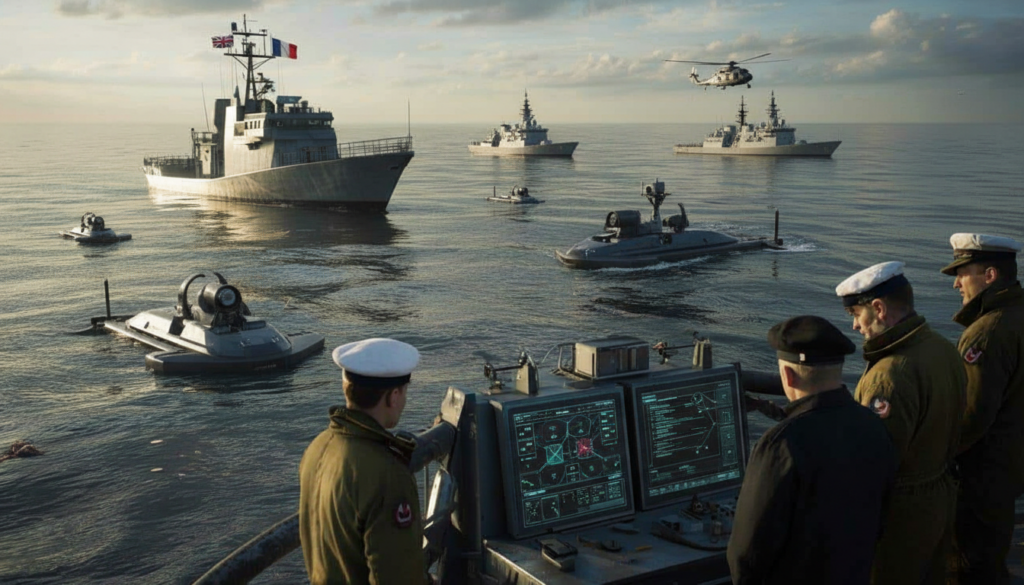
As a small Royal Navy mine hunter leaves Portsmouth, the English Channel is calm on the surface, a slate grey colour that doesn’t care. On the back deck, sailors hunch over screens that glow in a spooky blue light and watch ghostly shapes rise from the ocean floor. Some rocks are not dangerous. Some of them are not. A French officer in a navy parka whispers in English with an accent a few meters away. He points to a new interface that was just loaded that morning. It’s a Franco-British AI prototype that can find deadly mines faster than any human eye.
The scene only lasts for a short time. The algorithm calls a red icon on the screen a “high-probability threat.” The ship slows down. No one says anything. Everyone believes in a system that wasn’t there a year ago.
This is what the allied defence looks like in 2026.

When AI and old sea mines hit each other in the Channel
The future and the past are mixed up under the surface of the Channel. Old World War mines, new Russian-made gadgets, and unidentified metal junk from decades of shipping all sit on the seabed like a messy attic. Every unclear sonar echo could be a bomb that was about to go off for British sailors who had to clear paths for warships and commercial cargo.
There has been a lot of pressure on London to make this dangerous, grinding job more modern. The answer didn’t come from Silicon Valley; it came from across the Channel. France, which has a long history of naval robotics and mine countermeasures, is rushing in with algorithms, underwater drones, and a very specific promise: to teach British systems to “see” underwater threats the way a trained diver does, but a thousand times faster.
A British unmanned surface vessel slowly sailed through a test area off Brest that was filled with fake mines. Next to it, a French AUV (autonomous underwater vehicle) silently moved around, using high-resolution sonar to scan the seabed. The French side didn’t send raw sonar images back to analysts. Instead, they sent the data to a shared AI engine that Thales in France and UK partners worked on together.
The British crew was almost confused by what happened. The new interface showed clear labels like “Likely mine,” “Probable debris,” and “Suspicious pattern,” which was a big change from the fuzzy black-and-white blobs they used to see for hours. A job that used to require a whole shift of specialists now felt more like managing an inbox. We’ve all been there: the moment you realise that a machine might soon be able to do the hardest part of your job.
This faster cooperation between France and Britain isn’t just a feel-good tech story that has to do with defence. It’s based on simple strategic maths. AI research costs a lot, but sea mines are cheap. Russia has been quickly updating its own naval mine warfare and looking into civilian shipping lanes. The UK can’t afford to face that threat on its own after years of budget pressure and old mine hunters.
France has an edge in underwater robotics for industry and a national policy that makes mine warfare the most important part of sea control. Britain has years of experience clearing mines in the Gulf and North Sea, as well as a lot of NATO and commercial shipping duties. In short, Paris gives new code and platforms, while London gives battle-tested tactics and a lot of need. The AI that is being born between them is the kind that doesn’t make flashy tech ads very often, but it does quietly decide who owns the world’s chokepoints.
How the new anti-mine AI really works at sea
The new Franco-British system starts with a seemingly simple idea: teach machines to see the seabed as a city map. The AI learns to see “neighbourhoods” in sonar images, like sand waves, rocky areas, and wreck fields, and then find things that don’t belong. Each AUV pass is like Google Street View for the ocean, and it gets updated almost in real time.
The system also uses thousands of labelled mine shapes, such as spherical, cylindrical, buried, and tethered. French datasets from the Atlantic and Mediterranean are being combined with British archives from the Gulf and North Sea. The AI doesn’t just say “object detected.” Instead, it gives a more detailed probability based on the object’s shape, shadow, reflection, and even how it “ages” between missions.
The biggest change for British crews is how missions are run. In the old model, ships would collect data for hours and then go through it all at once. People were always tired and bored, which was a constant danger. Analysis now happens almost in real time. The AUV scans, the AI flags, and the command team can change the drone’s path right away to get a better look or send in a smaller robot for a closer look.
Engineers quietly added a new type of dummy mine with a strange shape during one trial. The AI had never seen anything like it before. It still marked the object as “significantly anomalous” compared to the rest of the seabed and moved it to the top of the list of things to look at. The British officer in charge of the test later said that on a bad day, a tired operator might have missed it. That direct comparison hits harder in uniform than any shiny PowerPoint.
This AI has a logic that goes beyond just recognising patterns. The system is meant to learn from all missions, not just the ones that go perfectly. When a British or French team later says, “Yes, that was a mine” or “No, just an anchor,” that information goes back into the shared model. Mistakes aren’t just accepted; they become fuel for training.
This is why France’s quick response is more than just symbolic diplomacy. Paris has promised to send updates to Royal Navy platforms very quickly, much faster than the usual defence procurement cycles. A bug found on a French frigate in the Mediterranean can lead to a software update that makes a British mission in the North Sea better a week later. In defence, that kind of speed is almost revolutionary. It turns two separate navies into a single, distributed sensor-brain that stretches from Brest to Plymouth.
The human side: trust, shortcuts, and quiet fears on board
People on the bridge of a mine-hunter don’t trust new technology just because a European minister smiled at a signing ceremony. It’s in small things, like a watchkeeper looking at the AI recommendation before making a decision or a senior diver asking for the “AI shortlist” when planning a clearance run. *This is when a software update becomes second nature to people.
French trainers who work with British crews spend less time on the maths behind neural networks and more time on simple methods. One of them tells a group of sailors, “Think of the AI as a very fast, very junior analyst.” “It can sort through everything and find the strange things, but it has never felt the shockwave of a real mine going off. That’s still your job. Some people nod their heads, and some people clench their jaws.
There is also the quiet, very human urge to rely too much on the machine. People start to relax when the system has been “right” for days and it sees shapes that look like mines and turns out to be exactly that. Screens start to feel good. The sea gets less dangerous and more like a video. Let’s be honest: after a long, boring shift, no one really checks every single alert with the same level of attention.
When French officers talk to British officers, they are very honest about this. They talk about their own mistakes with automated sonar interpretation in the Mediterranean, when crews stopped questioning the machine and almost missed a mine that was buried in the approach to a harbour. The answer is simple but hard: regular drills where the AI is wrong on purpose, making people relearn their scepticism and their craft.
People are proud and worried about this new AI partnership when they talk about it in private.
A Royal Navy clearance diver says quietly, “Ten years ago, we were diving in black water with a rope and a prayer.” “Now a French algorithm tells me where to jump. Thank you. And I’m not completely at ease. “Both can be true.”
Around that tension, useful rituals are starting to take shape:
Crews keep a “human override” log that shows when they disagreed with the AI and why.
Joint Franco-British reviews compare those logs to the real results, not to point fingers, but to improve the model.
Young sailors learn that “AI green” is a tool, not a sure thing, just like good weather or calm seas.
Military formality makes it easy to miss the emotional subtext. This community counts mistakes in lives and lost ships, not lost clicks. Using AI here isn’t a tech trend; it’s a brave act of silence.
What this underwater alliance says about our uneasy future with AI
The partnership between France and Britain on AI-driven mine warfare is a small part of a much bigger story. Two neighbours who fought over the Channel for hundreds of years are now connecting their seabeds with shared code. Every time a new version of the software is built, it goes to both French and British decks at the same time. Every update makes a “normal” day at sea feel a little different for the people who are on watch.
The effects spread far beyond naval strategy
Civilian shipping companies are already trying to get access to some of the safer routes that these AI-enhanced surveys have found. Environmental groups want to know if high-resolution maps of the seabed could help keep an eye on fragile ecosystems as well as hidden explosives. NATO planners are quietly looking at the Franco-British model as a guide for other shared AI capabilities, such as drone swarms and anti-submarine warfare.
For those of us watching from the shore or on our phones, this story raises a more personal question. What are we really outsourcing when we move life-and-death decisions from people who are full of adrenaline to calm, humming models? Sea mines are a clear place to welcome automation because they move slowly, sneakily, and without regard for human life. But the image that keeps coming up from these ships is not a robot-filled future, but people constantly having to decide when to help and when to give up.

This Franco-British AI shows what a more mature version of that negotiation could look like. Shared risk, shared information, and shared doubt. A system that doesn’t replace the person who hears the explosion, but gives them one more chance to avoid it. That might be the real test we use to see how smart our machines are in the future, whether we’re talking about war zones, hospitals, or city traffic.