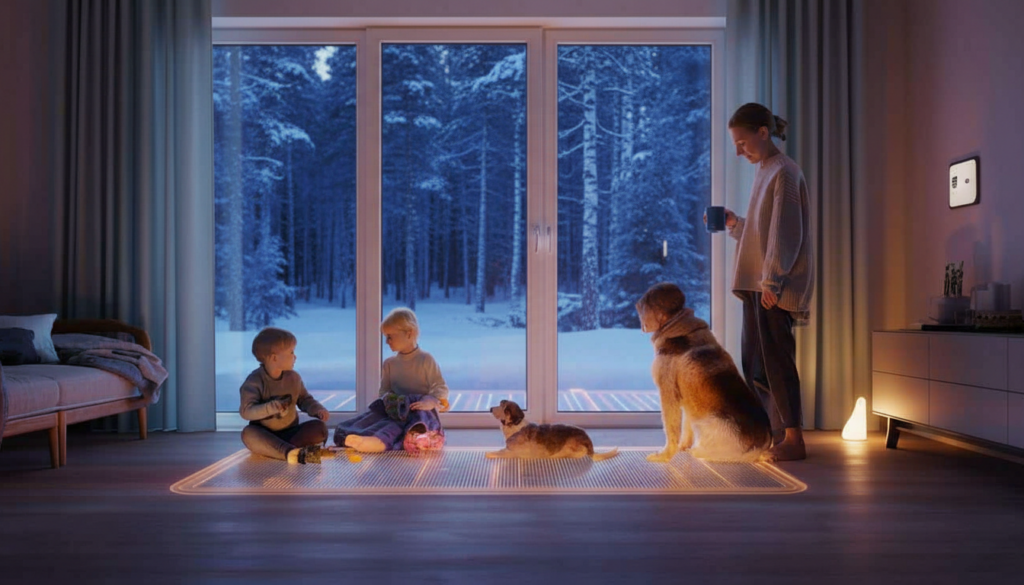
In the winter, the first thing that hits you in Finland is the quiet. The snow makes everything sound softer, the light disappears before you finish your coffee, and the cold presses against the windows like a living thing. When you walk into a house in Helsinki, you expect to see the usual European scene: rows of radiators under the glass and metal ribs ticking and clanging.
There is nothing on the walls, though. There are just clean lines, wooden floors, soft rugs, and people walking around in socks, looking very comfortable.
The air is warm. Not too hot or too dry. Just a steady, quiet warmth.
You look around in confusion, and then you see it, right in front of you.
The “heating system” that everyone is using is something you probably have under your feet right now.
A thing that hardly ever gets credit.
An item that could change the way you heat your home.
How Finns use something you already have to heat their whole homes
Many Finnish homes don’t have big radiators, humming fan heaters, or visible air vents. The warmth comes from below, from a system of pipes or cables that turns the whole floor into a low-temperature radiator. Heated floors. The same place where you spill coffee. The same surface that kids sit on to play.

It feels a little magical to someone from a place with white metal radiators. When you take off your boots and step onto the wood or tiles, you feel a soft, even heat, like standing on a rock that has been warmed by the sun. The temperature in the room isn’t tropical, but you feel warmer, deeper in your body, as if the cold outside has been politely blocked at the door.

Sanna, who is 32 years old, lives in a small three-room apartment on the outskirts of Tampere. She laughs when I ask her where her radiators are. “We don’t have any,” she says, moving her toes around in thick wool socks. Electric heating cables run quietly through every room under the laminate flooring. There is a smart thermostat on the wall that looks more like a light switch than a control panel.
Her living room stays at a comfortable 21°C even when it’s –15°C outside in January. No hot corners, no cold hallways. The family’s old apartment had traditional radiators that made strange microclimates, with hot spots near the windows and cold spots near the sofa. The heat covers the whole room evenly, like a soft blanket has been thrown over the apartment.
This “invisible radiator” works so well because of a simple physical reason. Warm air rises, and underfloor heating starts at the feet and legs, which are the parts of our bodies that are most sensitive to cold. The floor doesn’t blow hot air from a single metal box; instead, it lets out gentle heat over a wide area. That means you can be comfortable at lower air temperatures, which is important when energy prices go up.
The floor mass itself gets warm, which makes it act like a slow, steady thermal battery. At night, turn the system down a little, and the floor won’t lose its heat right away. This makes temperature changes less noticeable and stops the familiar on-off cycling feeling you get with wall radiators.
The Finnish way: small changes, big warmth
Underfloor heating sounds like a fancy feature from design magazines when you look at it from the outside. In Finland, though, it is used in very normal ways. Putting electric heating mats in the bathroom or entrance hall is a common way for many homes to get started. In the winter, those are the coldest places where tiles can hurt your bare feet.
The same reasoning can be applied to each room. A thin heating film under the laminate or vinyl in the bedroom. The ground floor had water-based underfloor circuits that were connected to a heat pump. The house changes from a bunch of metal boxes along the walls to one big, quiet panel under your feet. Your floor, which you already own, becomes the star of the show.
The biggest mistake new users make is to treat underfloor heating like a regular radiator: turning it up, turning it off, and messing with it every few hours. Floors take longer to respond. They should stay at a stable, slightly lower setting so that the mass of the slab or screed can do its job.

Let’s be honest: not everyone does this every day with their old radiators. People forget to bleed them, leave windows open for too long, or put furniture in front of them. A calmer approach works better with underfloor systems. Set a reasonable temperature goal, close any obvious drafts, put a thick rug where you spend the most time, and then let the system find its own quiet rhythm.
Over a cup of coffee, 58-year-old carpenter Jari from Oulu said, “I grew up in a house with big oil radiators.” They worked, but the air was always dry and my feet were cold. When we fixed this place up, I told my wife, “I want the warmth under us, not stuck to the wall.” He put in an air-to-water heat pump that heated the floor with water. His gas bill went down, but what he talks about the most is how comfortable it is:
“You don’t hear anything.” You can’t see anything. You just feel… fine.
Start with small areas like bathrooms, entryways, and kitchens to try out underfloor heating without having to redo the whole house.
Use what you have: thin electric mats can be put over existing slabs and work with laminate, vinyl, and many types of tiles.
Think low and steady. A floor temperature that is a little lower and stays the same is often better than short bursts of high heat.
Leave room to breathe; don’t cover heated floors with thick, wall-to-wall insulation under furniture.
Combine wisely: Use underfloor heating with a heat pump or good insulation to save money on energy bills and stay comfortable.
What this “invisible radiator” from Finland says about our own homes
If you walk out of a Finnish home on a dark February afternoon, you’ll notice something else. No one talks about how great their heating systems are. They talk about how it feels to come home, with kids playing on the floor in T-shirts while the world outside is frozen blue. The main feature is usually not the underfloor heating. It’s just a part of how spaces are designed to be lived in, not just put up with.
That simple, everyday way of thinking is what makes the idea so easy to spread. You don’t have to live near the Arctic Circle to use the idea. Perhaps it’s a 4 m² bathroom in a city flat where your toes are always cold. It could be a cold living room on the first floor where the radiators never quite reach the corners. *Starting with the floor changes how you feel about the whole room.
The truth is that a lot of us still think of heating as an afterthought, something to pay for instead of something to make us comfortable. But the Finnish example shows how one familiar thing, the floor, can change that relationship. Not through big events, but through steady behavior.
You might not be ready to take out all the radiators tomorrow. You may never live in a home where warmth rises gently from every square meter. But the next time you go home on a cold day, you might look down for a second. Think of the ground under your feet as more than just a place to walk; it’s the engine of your comfort.
| Key point | Detail | Value for the reader |
|---|---|---|
| Using the floor as a radiator | Underfloor heating spreads low-temperature warmth across a large surface | More even comfort with fewer cold spots and drafts |
| Start in the coldest rooms | Bathrooms, entrances and ground floors benefit most from warm floors | Practical first step without fully renovating your heating system |
| Low and steady operation | Floors work best with stable temperatures, not constant adjustments | Potential energy savings and a calmer, more predictable home climate |
FAQ:

Question 1: Does underfloor heating only work in new homes, or can it also work in older homes?
Question 2: Is it more expensive to run than regular radiators?
Question 3: Can I use underfloor heating with wooden floors or just tiles?
Question 4: Do I have to take up the whole floor to put it in?
Question 5: Is it safe for kids and pets to have underfloor heating?
 Farewell to hair dye for grey hair, this simple conditioner add-in restores natural colour