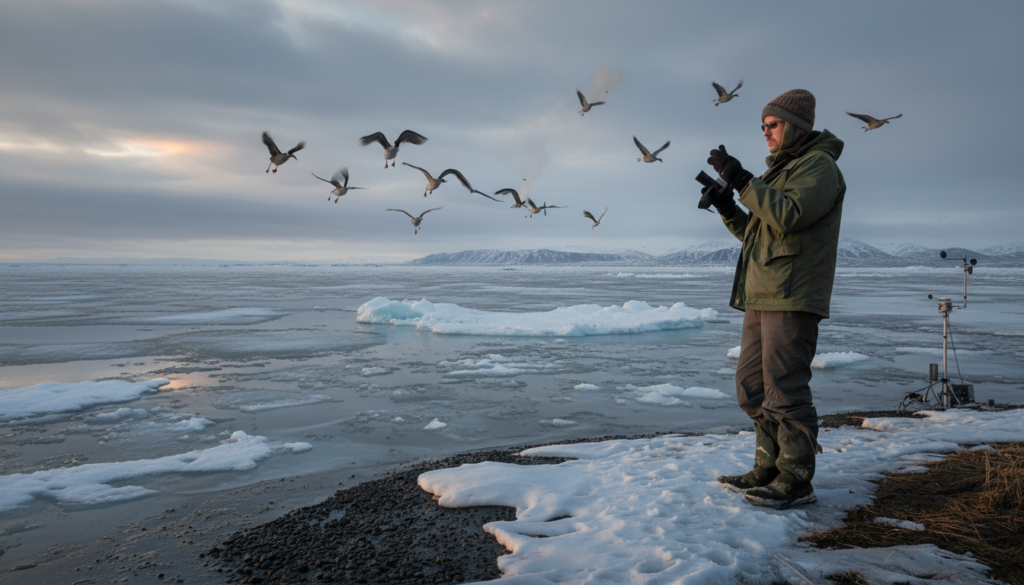
The first sign that something was wrong was a whisper: the sound of wings where there should have been snow. Maya Larkin, a birdwatcher, raised her binoculars on a grey February morning near Lake Superior. She was expecting the usual winter quiet. Instead, she saw something moving above her. A loose V-shape of Canada geese flew over the water that was only half-frozen, calling to each other like it was spring two months early.
The air felt strange and soft. There were puddles on the ice, and a mosquito that didn’t know what to do was flying around her glove. Maya looked at the date on her phone. At the beginning of February. It’s still deep winter, at least on paper.
Far to the north, meteorologists were looking at their own kind of disturbance: an Arctic breakdown that was breaking up the frozen order of the season.
The animals were paying a lot more attention to that change than we are.
When winter stops being winter
This year, meteorologists in the Northern Hemisphere are keeping a close eye on early February. The polar vortex, which is a tight ring of cold air that usually stays above the Arctic, is wobbling and tearing. This lets warm air move north and cold air move south. It looks great on satellite maps, almost like ink swirling in water. It feels strange wrong on the ground.

Fields that should be hard under boots become soft. Frogs start to croak from ditches that froze solid only a week ago. The calendar says “mid-winter,” but the air smells like wet leaves and thawed mud. Every animal that migrates has learned to read that smell.
One of the most clear signs is coming from Europe’s wetlands. In the Netherlands, ornithologists say that flocks of barnacle geese are leaving their winter homes days, even weeks, earlier than usual. Storks that used to fly to Africa are now staying in Spain for most of the winter because the weather is milder and there is plenty of food in landfills.
Along the East Coast of the U.S., wildlife rehab centers are reporting seeing monarch butterflies flying north earlier than usual during the first fake warm spell. A few sunny afternoons in February will be enough to wake them up from their sleep. Then a strong Arctic wind blows back, and volunteers find the delicate bugs frozen in place under eaves and hedges.
These aren’t just funny stories for people who love nature. They are warning lights on a much bigger dashboard.
When meteorologists talk about an Arctic breakdown, they mean a chain reaction that starts with temperature and ends with daylight and moisture. Animals that move use a mix of signs, like longer days, warmer air, and the first signs of insects or plant buds. Those signals get messed up by a sudden heat wave in February followed by a brutal cold snap.
Birds might leave their breeding grounds before the insects hatch. Caribou might start moving when the snowpack is still dangerous, which wastes a lot of energy. Salmon might not run at the right time with the river’s flow. It’s hard to understand the science here: a few days of mismatch can mean fewer chicks, weaker calves, and whole groups of animals that are lost in the data.
It looks like “strange weather” to most of us.
How scientists deal with the mess
This isn’t just a climate graph that shows how things are changing. It’s usually just one person standing outside in the cold with a notebook, a smartphone app, and a strong sense of routine. Ecologist Sam Patel goes to the same reedbed in a wetland in eastern England three times a week at dawn. He enters every call, wingbeat, and strange absence into a simple digital form that goes into a global database.
In Nunavut, Inuit hunters still write down the dates of caribou on old-fashioned paper logs and then give those dates to Arctic researchers. Different languages, different tools, but the same idea: don’t break the chain of observation.

*If it weren’t for those steady eyes on the ground, the Arctic breakdown would just be another pretty picture on a scientist’s screen.*
We’ve all been there: you mean to write something down “later,” but later never comes. Every winter, citizen scientists have to fight the same urge. Life gets busy, days are short, and phones die when it’s cold. But those entries that were skipped are where blind spots show up.
Some records of bird migration that have been kept for a long time go back more than 50 years. It’s not the end of the world if you miss a season here and there. The real problem is when whole sites stop working just as the climate signal is getting stronger. Let’s be honest: no one really does this every day.
That’s why coordinators tell volunteers more and more to not chase perfection but continuity.
Dr. Lena Krauss, a climate scientist who works with European migration data, says, “Arctic breakdowns used to be once-a-decade headline events.” “Now we see big problems almost every winter. The animals are already changing their schedules. The question is whether we are changing how we watch things just as quickly.
Her team has begun sharing simple, easy-to-follow rules so that anyone, from professional biologists to high school bird clubs, can use the same system. You might think that seeing one goose or hearing one frog call from your backyard is not a big deal. When you look at a lot of them, these data points show how migration cues change from year to year.
Write down the date and time of your observation.
As best you can, write down the exact location.
Stay with simple groups like species (or “unknown duck”), number, and behavior.
You can upload to a well-known site like eBird, iNaturalist, or a local project.
Do it again from the same places whenever the weather in February seems “off.”
A winter that doesn’t belong to any one generation
If you’ve never known anything else, an Arctic breakdown can feel very normal. A 12-year-old in Ohio who sees robins hopping around on a February lawn may never know that their grandparents saw the first robin as a sign of late March that was almost holy. A young reindeer herder in northern Scandinavia might think that rain on snow in the middle of winter is normal, not a dangerous layer that can starve herds by keeping lichen from getting to them.
These changes are just as real in memories as they are in temperature graphs. That is why scientists are asking older people for their stories more and more, along with satellite data. It’s also why they get worried when early thaws turn into just another “funny winter” instead of a flashing red sign.

Questions and Answers:
What is a “Arctic breakdown,” and how is it different from the polar vortex?
Question 2: Why do warm spells in February make it so hard for birds and animals that are moving to find their way?
Question 3: Can one strange winter really change the paths of long-distance migrations?
Question 4: Is there anything else that regular people can do besides changing their own carbon footprint?
Question 5: Do scientists think that wildlife can adapt to these quick changes in the seasons?