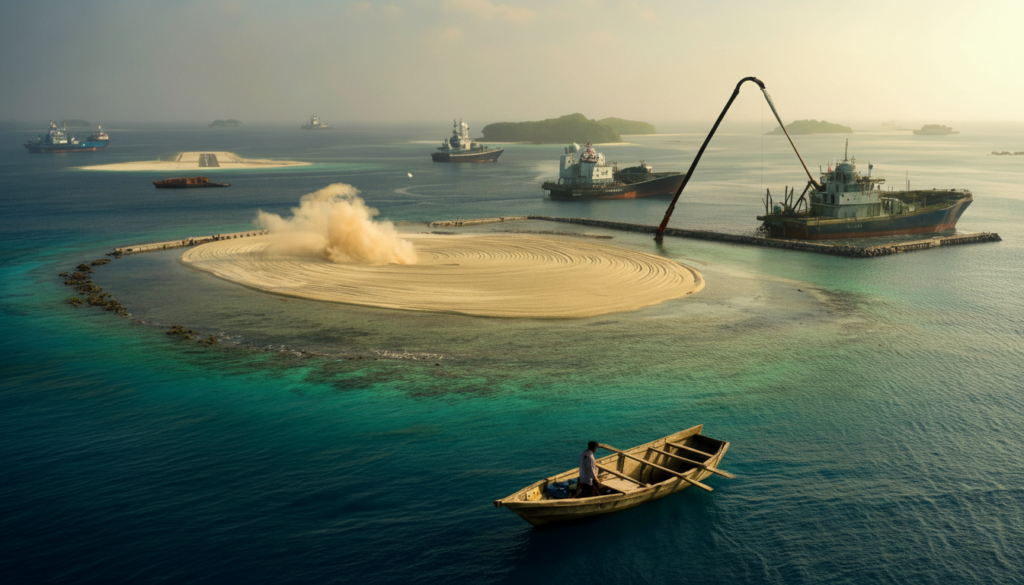
A Filipino fisherman steers his boat toward what his grandfather says used to be open water on a foggy morning in the South China Sea. A runway, radar domes, cranes, and neat rows of buildings sitting on turquoise water that is no longer just water rise up in front of him under a hazy sun. There was only reef here twelve years ago. Now it’s a hard, man-made island with a Chinese flag flying in the wind.
He stops the engine and listens. The low thud of dredgers echoes in the distance, like a construction site floating on the horizon. They are still pumping sand from the ocean floor, grain by grain, changing blue into beige and shallow water into land.
There is a question that no one can agree on somewhere between those grains of sand.

One grain at a time, China turned empty sea into solid land.
From the sky, China’s new islands look almost fake, like someone dropped Lego bases into the ocean and forgot to pick them up. Lines of reclaimed land that look like they were cut out of the natural curves of coral reefs. Ships that are as big as small towns go around them, dragging long black hoses that suck up sand from the bottom of the sea and spit it out in pale, growing rings.

This marathon of dumping sand began in the early 2010s, slowly at first and then very quickly. In a few years, flat, tan platforms appeared where sailors used to carefully steer around shallow reefs. Heavy machinery, not tides or time, was changing the sea itself.
Fiery Cross Reef used to be a lonely patch of rock and coral that waves would bully. It was mostly underwater at high tide in 2012, and it was barely a dot on maritime charts. Satellite pictures from 2016 showed a 3,000-meter runway, a deep-water harbour, and rows of hangars on 2.7 million square meters of new, man-made land.
Engineers had been dredging and dumping sand day and night, with the help of GPS and the protection of coast guard ships. It started out as a reef where fishermen could catch fish, but it has now become an airstrip that can handle bombers and surveillance planes. Local fishermen say that the change happened so quickly that they went out one season and came back to find a new shoreline where waves used to break.
There is a simple but explosive logic behind the show. The UN Convention on the Law of the Sea says that natural islands can create huge exclusive economic zones. Not all of them automatically have the same rights. So when China turns a reef into an island, it’s not just moving sand. It is pushing the limits of international law, betting that concrete and runways will be more important in the end than legal footnotes.
The land is real, but the law is up for debate. Power usually goes with what can be seen, built, and defended. That’s the uncomfortable truth that comes with every new strip of beach.
The quiet way behind a very loud political statement
The basic recipe is almost too easy to follow. You take a reef that is mostly underwater or not very visible. You put rock and sheet piles around it to keep its shape. You sail in dredgers and suck up sand, gravel, and coral from the seabed nearby. Then you blast the slurry into the enclosed space until it rises above the waterline. After that, you level it, pack it down, and start pouring concrete like you would on land.
This is what engineers call land reclamation. A new airfield is what pilots call it. States along the coast say it’s a problem. Each new artificial island stays where it is, like a fixed pawn in a region where the sea used to change all the time.
For people who live near the South China Sea, this isn’t just a game of chess. A Vietnamese captain in his fifties tells reporters that the fishing grounds he usually goes to near Subi Reef changed “like someone slammed a door” in his face. He used to anchor near the shallow reef and trade cigarettes and gossip with other crews in the area under the stars.
Then, almost overnight, patrol boats showed up. Chinese loudspeakers yelled at him. What had been open water for decades was now a restricted area, with ships flying a flag he didn’t recognise as local. One season, he pulled up nets full of fish. The next thing he heard was nothing but silence and warnings to leave.
People who study the reclamation boom say that this change didn’t happen by chance. It was easy to see what they were doing: find disputed features, turn them into strongholds, and surround those strongholds with a “rights” halo at sea. The dredgers bring the sand, but the plan brings something heavier.
China is pushing its neighbours and outsiders into a new normal by making facts on the water. In this new normal, maps bend toward the presence of steel and concrete. You can file legal protests, hold press conferences, and hold tribunals. The islands stay still. They just sit there, with the runway lights on at night, while everyone else fights over paperwork.
What makes these islands scary, interesting, and a little bit like déjà vu
You can almost forget about the politics if you watch how the work gets done. The chaos is strangely exact. Dredgers follow set paths. Survey ships leave neat lines behind them. Barges are lined up like checkout lanes, ready to unload steel and rock. This is what happens in an industrial setting, even though we like to think of it as wild and untouchable.

The method has been improved over the course of twelve years of hard work. Pumps that work faster, better models of how sand moves, and stronger sea walls to protect against typhoons. China has turned a technical skill into a strategic habit over time: where it wants to be, it pours land.
A lot of people see the pictures and immediately think of Dubai’s palm-shaped islands or the huge airport expansions that were built on reclaimed coasts. That comparison isn’t crazy; it’s just not complete. City projects sell views and shopping centers. The islands in the South China Sea sell security, reach, and quiet control over shipping lanes that are important to the world economy.
But the emotional response is the same. When people change coastlines at will, it makes them feel both awe and discomfort. We’ve all been there: you see a satellite image of the same place before and after something happened, and your stomach drops a little, even if you can’t quite put your finger on why.
Environmental scientists give a clear warning that cuts through all the talk.
A marine biologist in Manila says, “Reefs that took thousands of years to build can be buried in a season.” “You can’t just flip a switch and get that biodiversity back.”
Fishermen say that the water around the new islands is muddier and there are fewer coral species.
- Reefs blasted and dredged—this destroys the very base of all marine life.
- Shipping lanes change shape without much public discussion. Ships change course to avoid sensitive areas.
- New military bases, like radars, runways, and missile sites, change the daily risk calculations in the area.
Let’s be honest: no one really reads maritime law for fun. But these changes are already affecting global trade, fuel prices, and even the fish that land on dinner plates far from Asia.
When you can build your own coast, who really owns the ocean?
*The more you look at these islands made of sand, the more they seem like a test of what it means to own something at sea.* The law says one thing, the dredgers say another, and the countries next door are angry and realistic at the same time. They protest, send patrols, and look for allies, all while seeing new piers and bunkers pop up on satellite feeds every month.
For regular people, the question hits closer to home than they might want to admit. Just because someone has the machines, the money, and the time to pile up enough sand, who gets to draw a line in the water and say it’s theirs?
| Key point | Detail | Value for the reader |
|---|---|---|
| How the islands are built | Dredging, sand dumping, sea walls, and rapid construction on former reefs | Helps you visualize the physical process behind the headlines |
| Why it matters geopolitically | Artificial land shifts power, patrol routes, and negotiation leverage in the South China Sea | Shows how distant disputes can affect trade, security, and daily life |
| Environmental and legal fallout | Reef destruction, fisheries disruption, and intense disputes over maritime rights | Invites you to question how far technology should go in reshaping shared spaces |
FAQ’s:
Question 1: Are China’s artificial islands legally “territory” with full maritime rights?
Question 2: How long does it take to turn a reef into a fully operational island base?
Question 3: Do other countries also make fake islands in the South China Sea?
Question 4: What kind of military buildings do these islands usually have?

Question 5: Is it possible for the damaged reefs and ecosystems around these islands to ever get better?