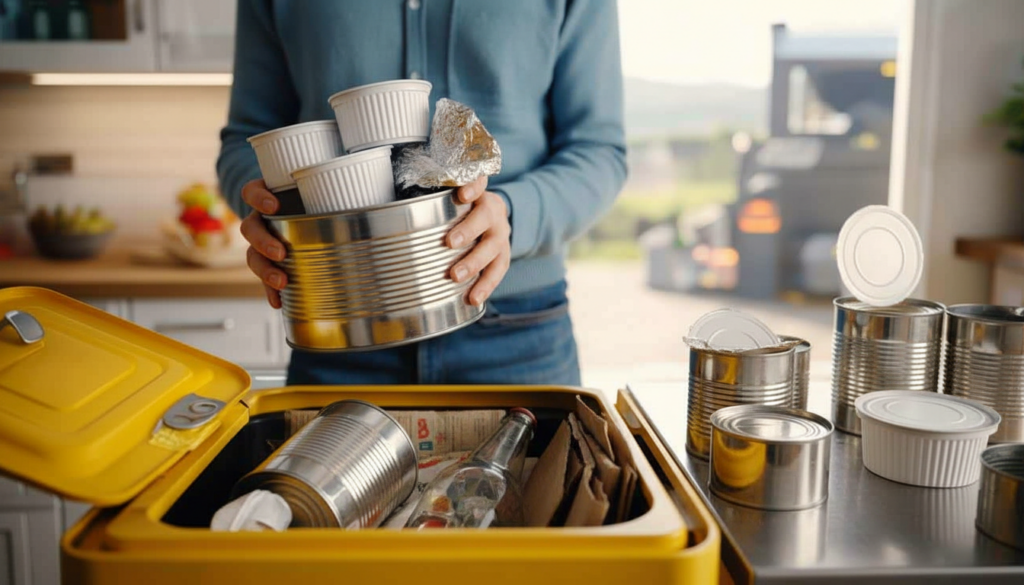
Yoghurt pots were the awkward child of recycling for years. People weren’t sure what to do with them, so they either guessed or just threw them away with the rest of the trash. The plastic used, their light weight, and the food residue made it hard to process them in large quantities.
Recycling networks are now better than before. In most parts of France, those pots can go in the well-known yellow bin with other packaging. You don’t have to rinse them perfectly; just throw away most of the yogurt and put the pot in.
You can now put empty yogurt pots right in the recycling bin, but you have to separate each one from the others.

That last point sounds like a small thing. No, it is not. What you decide at the kitchen counter has a direct effect on how much plastic or metal can be recycled.

Why you should never stack yogurt pots and cans
A lot of people push the foil lid into the pot and then put the pot itself into a tin can or another container to save space. It’s easy to see why: fewer loose items, a cleaner bin, and fewer trips to the outside container.
That “hack” is a problem for a sorting center.
When you stuff different materials into each other, machines think they are one thing, and the recycling stream gets dirty.
Every type of packaging has its own path:
- Plastic yogurt pot: first, a plastic sorting line, and then plastic reprocessing
- Metal can: a line for sorting metal, then melting it down and making it again
- Foil lid: very thin metal that is collected and processed on its own
Optical readers and other automated systems often can’t tell the difference between a pot and a can or a foil lid and a pot. The whole package could end up:
- Put in the wrong material stream by mistake
- Not accepted because it was “non-compliant waste”
- Instead of being recycled, they were sent to be burned or buried.
How sorting centers really handle your trash
Recycling in modern factories is mostly done by machines. Cameras, lasers, and air jets quickly find and separate packaging. People step in, but they can’t untangle every “Russian doll” of mixed waste by hand.
Sorting machines can tell shapes and surfaces apart, but they can’t open a can and see what’s inside.
In a normal center:
| Stage: | What happens |
|---|---|
| First screeningItems that | are too big or dangerous are taken away. |
| Mechanical separation: conveyors, | magnets, and sieves break things up by size and weight. |
| Sorting with lightReaders | tell the types of plastic, cardboard, and paper apart and direct them. |
| Control of qualityOperators | look for contamination and get rid of things that aren’t safe. |
When you put a can and a yogurt pot together, the machines usually put the whole thing in one stream, which is usually metal. That means that plastic that gets stuck inside gets out of the plastic circuit completely. If the bundle looks suspicious or too complicated, it might be turned down.
Recycling of mixed materials is of lower quality
Recyclers want streams that are clean and made of only one material. That doesn’t mean perfectly clean, but it does mean that you can clearly see it and separate it by hand. When a stream has a lot of different things in it, the quality of the recycled material goes down.
Recycled plastic that isn’t very good can be harder to sell, not as useful, and only good for making lower-quality products. The entire economic calculus of recycling becomes more tenuous.
Better separation at home means better recycled plastic and metal, and it also saves councils money on processing costs.
The French group Citéo, which helps local governments recycle packaging, sums up the message with the simple phrase, “Sorting is good; sorting by separating is better.” This logic works in many places, not just France. When people don’t mix up their materials, any system that relies on automated sorting works better.
Tricks to save space that don’t work
Common “bad habits” that have a big effect
People who work in recycling often see the same things in yellow bins:
- Yoghurt pots packed tightly into cans
- Foil lids crumpled up and put into plastic bottles
- Different kinds of plastic taped together
- Small things stuck inside bigger things, like bottle caps stuck in cans
All of these things make it harder to scan and separate. Some items look like the wrong material. Some get shredded, but the contamination stays inside, which lowers the value of the final recyclate.
When the wrong kind of trash gets into the yellow bin
French sorting centers also have to deal with the problem of people throwing away things that don’t belong with packaging. Fabrice Berger, who is in charge of the syndicate that runs the Bourges sorting facility, says that he has found tires, car rims, and even long metal bars in recycling bins.

One piece of trash that isn’t packaging in the yellow bin can break machines, slow down the line, and cost taxpayers more money.
These intruders are not just mistakes. They can stop conveyor belts, knock sensors out of alignment, or make machines shut down right away. Then the staff has to safely clear the jam and restart complicated machines, which costs time and money.
Easy rules that really work in your kitchen
It doesn’t have to be hard to recycle. A few clear habits can make a big difference.
- Not clean, but empty: scrape out food scraps, but you don’t need to wash it with hot water.
- Take off the lids, caps, and films from the items and put them in the bin.
- Don’t nest: Don’t put one package inside another unless your local rules say you have to.
- Only put packaging in the bin, not broken things or scrap metal.
These steps help optical readers find each item, send it to the right conveyor, and keep the material streams clean. A few seconds at home saves a lot of energy in the long run.
Why rules in different places can be different
People often get confused because rules change from place to place or over time. That’s not just red tape. Not all of the local sorting centers have the same partners or technology. Some can handle more kinds of plastic or smaller things than others.
As facilities get better, new materials can be recycled. For example, yoghurt pots can be recycled in many parts of France. People usually find out about that change through stickers on bins, flyers, and labels on packages. Things that were good habits ten years ago might not be good habits anymore.
Checking your council’s updated advice every now and then helps turn good intentions into real benefits for the environment.
What “contamination” really means in recycling
There is a certain way that recycling professionals use the word “contamination.” It doesn’t just mean bad food or dangerous chemicals. In this case, contamination is anything that shouldn’t be in a certain stream.
A plastic pot that is hidden in a can is considered contamination in the metal stream. A cardboard box with a metal lid still on it is not good for the paper stream. Even small amounts can cut down on how much stuff gets reused.
If limits are broken, whole batches may be rejected or downgraded. That means that even though residents are trying to help, it costs local governments more and has less of an impact on the environment.
Everyday situations that show what’s at stake
The family of four and the bin that comes once a week
Think about a family of four who eat two yogurts every day. That’s 56 pots a week. If they always push every pot into tins or stack them on top of each other and shove the pile into one big can, a whole week of plastic that could be recycled could get lost.
If a whole town did that, tens of thousands of pots might never make it to the right processing line. The numbers that say “yoghurt pots are recyclable” are too high for what actually gets recycled.
The myth of the lazy rinse
A lot of people think they have to rinse every pot under hot water or else they can’t recycle. Most systems only need you to scrape out leftover yogurt with a spoon or spatula. The most important thing is to put the item in the right bin and keep it separate, not to make it shine.
It’s always better to recycle a pot that was quickly scraped than to throw away a pot that was perfectly cleaned.
Other hard-to-separate packages besides yogurt
This same logic works for a lot of other things we use every day:
- Close the cap on cardboard juice cartons with plastic caps, but don’t put any extra plastic inside.
- Take off the metal lids on glass jars and recycle each piece in the right stream.
- If you can’t recycle multi-layer snack packaging in your area, don’t mix it with “good” streams.
Knowing that each visible material usually follows its own path makes it easier to make quick decisions at home. When you’re not sure, it’s usually safer for the system to separate pieces instead of putting them together.
Little things add up to big things.
Percentages, tonnes, and CO₂ savings are some of the numbers that come up when talking about recycling. Putting a yogurt pot inside a tin can feels like nothing compared to that. But sorting centers can see the pattern on a larger scale: small, repeated shortcuts add up to real tonnages lost and equipment that is overworked.

Putting your empty tin can, foil lid, and yogurt pot in the yellow bin as three separate things is a small gesture. Still, it makes the way you work in the kitchen more like how machines sort and recycle. When environmental policy stops being theoretical and starts working in the real world, that’s when the alignment happens.