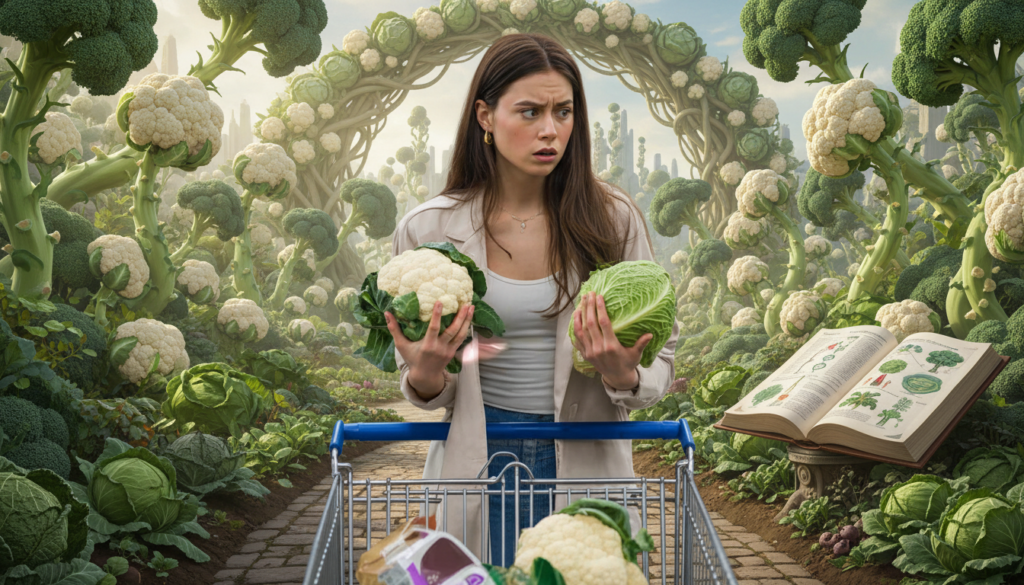
I saw a young woman park her cart in front of the vegetables on a Tuesday night in a busy grocery store. She picked up a big head of cauliflower, a bag of chopped broccoli, and some shredded cabbage for “detox salad.” Three different products, three different prices, and three different labels in her mind: low-carb, protein-friendly, and gut-healing. She looked at a diet app on her phone, scanned the barcodes, frowned, and thought for a moment.
No one else around her knew that all three were from the same type of plant.
That one quiet fact about plants was quietly affecting what she bought, what she thought was “healthy,” and what she was going to cook for the week.

One small mistake, multiplied by millions of plates.

One plant, three “foods”: the big blind spot for everyone
When we were kids, we thought that cauliflower, broccoli, and cabbage were three separate foods, like three different families. We put them in order: cauliflower is the low-carb hero, broccoli is the protein-rich sidekick, and cabbage is the base for the not-so-exciting coleslaw. We put diets on those labels.
But botanists will tell you something that sounds like a riddle: they’re all the same plant, Brassica oleracea. Just different parts that people have chosen and blown up over hundreds of years.
Knowing that changes the way you see the whole diet landscape.
Imagine a week of “healthy reset.” A fitness influencer shares meal prep boxes that include grilled chicken with broccoli for “muscle fuel,” cauliflower rice for “fat loss,” and red cabbage salad for “gut health and antioxidants.” Three roles, three colours, and three hashtags.
Without thinking, thousands of followers copy and paste the grocery list. They buy a bag of “rainbow slaw mix,” a plastic bag of pre-cut broccoli florets, and a branded pack of cauliflower rice. The receipt screams variety and class.
But genetically, they just paid three times as much for the same plant, which had been shaped into different shapes by centuries of selective breeding and modern marketing.
This is how the trick works. Our brains like to put things into groups, like this food for losing weight, that one for bloating, and another for energy. Food companies are aware of this and divide reality along those lines. Nutritionally, cauliflower, broccoli, and cabbage share most of their base profile: fiber, vitamin C, K, folate, glucosinolates. There are differences in amount and texture, but not as much as the diet world says.
The misunderstanding doesn’t just make things hard for us. It narrows what we think “eating varied vegetables” really means and quietly redirects our money toward products that only look varied in the bowl.
Changing your plate: from fake variety to real diversity
There’s a simple, almost boring method to get out of this trap: when you plan your meals, group cauliflower, broccoli, and cabbage together in your head as “one plant, many shapes.” Then ask: what other plants am I missing?
Instead of three cruciferous sides in one day, trade one of them for carrots, another for leafy greens, a third for beans or lentils. It’s not about banning anything. It’s about recognizing when you’re just eating the same thing wearing different outfits.

Once you start seeing Brassica oleracea as one family, your shopping list becomes more honest — and your nutrients more balanced.
The biggest mistake most people make is feeling virtuous because they “ate loads of veggies” while 80% of those veggies belong to that single Brassica family: cauliflower mash, broccoli soup, cabbage salad, kale chips. It looks colorful, so the brain checks the “variety” box.
We’ve all been there, that moment when you realise your supposedly diverse meals are built around the same few stars. You don’t need guilt, you need a tiny mindset tweak.
Let’s be honest: nobody really redesigns their entire diet overnight. But swapping just one Brassica portion per day for a totally different plant already changes the nutrient picture in a real way.
“Most modern diets overrate variety in branding and underrate variety in species,” a nutrition researcher told me. “People think they eat twelve foods, when it’s really four foods in twelve costumes.”
- Rotate by family, not by shape: count how many plants on your plate belong to the same species or botanical family.
- Use one Brassica per meal: if you have broccoli, skip cauliflower and cabbage in that same sitting.
- Chase color from different plants: orange from squash or carrot, red from beet or tomato, green from spinach or herbs.
- Switch roles: use beans or lentils where you usually rely on cauliflower rice or broccoli sides.
- Watch the labels: when “superfood” branding repeats the same base vegetable, treat it as one, not five.
The quiet power of knowing what you really eat
Once you see cauliflower, broccoli, and cabbage as siblings from the same plant, you can’t unsee it. Your fridge suddenly looks a little less diverse than you thought. Your “detox salad,” “low-carb base,” and “high-fiber side” all trace back to the same genetic root.
That doesn’t make them bad. It just strips away the illusion that eating them all in one day is some kind of extreme variety. *The diet industry thrives on that illusion, because it sells you three products instead of one idea: learn what’s actually on your plate.*
This new lens doesn’t require you to become a botanist or track every micronutrient. It asks a softer, more human question when you shop or cook: am I repeating the same plant out of habit, comfort, or marketing?
Maybe one night you swap cauliflower crust for a chickpea crust. Another day, you drop the broccoli side and sauté green beans with garlic. Tiny, almost invisible tweaks — yet over weeks, your gut bacteria meet new foods, your body meets new fibers, and your budget quietly benefits too.
What happens if more of us start eating this way, with species and families in mind rather than trendy labels? We’d rely less on miracle foods and more on plain variety. We’d see that “healthy” isn’t built on worshiping one hyper-marketed plant in seven shapes, but on spreading the spotlight across many humble ones.
The cauliflower–broccoli–cabbage trio will still have a place on your table, of course. Just not the starring role every single night.
Your plate tells a story about what you believe is different — once you know the truth, you get to rewrite that story.

| Key point | Detail | Value for the reader |
|---|---|---|
| One species, many shapes | Cauliflower, broccoli, and cabbage are all Brassica oleracea, selected over time for different parts of the plant. | Breaks the myth of “three totally different foods” and clarifies what variety really means. |
| Fake vs. real variety | Eating several forms of the same species feels diverse but repeats similar nutrients and plant compounds. | Helps you design meals with broader nutrient coverage and more interesting flavors. |
| Simple rotation strategy | Limit Brassica to one form per meal, and swap the others for totally different plant families. | Gives an easy, actionable way to improve your diet without rigid rules or expensive products. |
FAQ:

- Are cauliflower, broccoli, and cabbage really genetically the same plant?Yes. They’re all cultivated varieties of Brassica oleracea, selectively bred so different parts (flower buds, leaves, stems) became exaggerated over generations.
- Do they have exactly the same nutrients?No. They share a similar base profile, but amounts vary: broccoli, for example, often has a bit more vitamin C and certain phytochemicals, while cabbage may offer more crunch and water content.
- Does this mean I should eat them less?Not at all. They’re healthy vegetables. The idea is to avoid thinking that eating all three equals huge diversity, and to bring in other plants alongside them.
- What other vegetables balance out the Brassica family?Think carrots, beets, sweet potatoes, leafy greens like spinach, onions, leeks, tomatoes, peas, beans, and lentils — each adds a different nutrient and fiber profile.
- How can I quickly check if my diet is too Brassica-heavy?Glance at a typical week and count: how many meals lean on cauliflower, broccoli, cabbage, kale, Brussels sprouts, or collard greens? If they dominate, start swapping one or two portions for completely different plants.