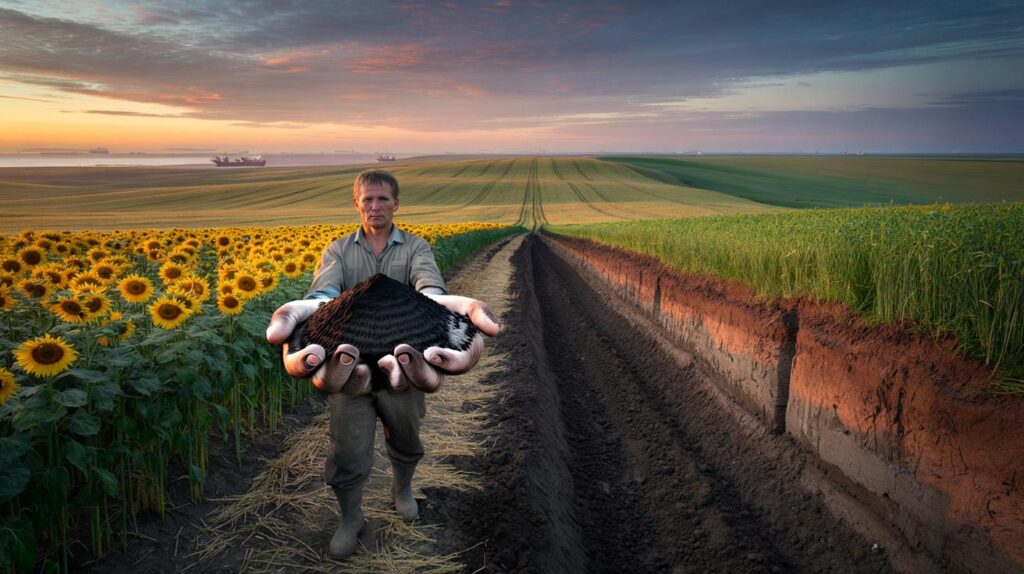
At dawn, the farmer leaves, his boots digging a few centimetres into what appears to be coffee grounds. The soil crumbles like chocolate cake between his fingers, so dark that it nearly snatches the light. Without any tools or laboratory testing, he is aware that this is his actual bank account. Not the city one. This one was silent, black, and deep beneath his feet.
We frequently discuss rare earths, lithium, and oil and gas. However, there is another type of wealth located here, spanning northern Kazakhstan, southern Russia, and Ukraine: a living, breathing resource that smells of decaying leaves and rain. It is referred to as their treasure by the locals. Chernozem, or “black earth” in Russian, is what scientists refer to it as.
It is now known by a different name throughout the rest of the world.

Why is this “black gold of agriculture” so unique?
The first thing you notice when you stand in a field of chernozem following a storm is not what you see. It’s the odour. That earthy, sweet, thick smell that clings to your clothing and seems to rise from the earth itself. Centuries of tall prairie grasses dying, decomposing, and blending into an organic feast have left the soil with a deep charcoal colour that is almost unsettling.
You can keep going and going if you push a spade in. The black layer is almost a metre deep in some areas. In central Ukraine, farmers often make jokes about how their topsoil is taller than their kids. It’s pretty close to the truth.
The scale of that richness is immediately apparent when you drive through the steppe in late June. Corn, wheat, barley, and sunflowers are just a few of the endless crops that seem to be floating over the horizon like a grain ocean. In good years, chernozem wheat yields in Ukraine’s Poltava region can reach 6–7 tonnes per hectare. It’s not a coincidence. That’s the soil at work in the background.
These lands could “feed half the world,” according to Soviet agronomists. They weren’t overly dramatic. Together, Ukraine, Russia, and Kazakhstan have grown to be one of the world’s largest breadbaskets, transporting grain, oilseeds, and flour from Egypt to Bangladesh. Bread prices fluctuate on all continents when war or drought strikes.
The actual subterranean process is both straightforward and miraculous. Humus, the dark, spongy organic material made from leftover plant matter and old grass roots, is abundant in Chernozem. It retains moisture long after the last rain and functions as a storehouse for nutrients and a sponge for water. Because of this, crops can remain green here even when nearby fields with lighter soils already appear worn out.
Chernozem’s structure allows roots to breathe and drill deeply. Microorganisms throw a continuous biochemical party, earthworms travel through it like tube trains, and pores between the particles store water and air. A simple seed becomes a fully loaded ear of wheat because of this peaceful life below ground. *That is the “black gold of agriculture’s” true secret.
From a breadbasket to a point of geopolitical pressure
View a satellite map of the world’s shipping lanes to get a sense of why Chernozem is strategically important. Grain ships departing Black Sea ports dispersed like tree branches, sailing toward Asia, the Middle East, and North Africa. Whole regions are affected when those ports slow down. Suddenly, import-dependent nations must rush, change suppliers, pay more, and occasionally ration.
Up to 30 cm of snow has been confirmed. The states are listed here, along with the crucial time
Satellite photos of burnt fields, destroyed grain silos, and closed ports during the conflict in Ukraine made a particular type of soil a worldwide issue. On their phone screens, dock workers in Lebanon, bakers in Tunisia, and traders in Shanghai were all indirectly gazing at the same damaged, dark ground.

Can the rest of the world take a cue from Chernozem?
The logic of any dusty plot can be borrowed, but it cannot be magically transformed into Chernozem overnight. Black earth’s “recipe” is slow, patient, and extremely obstinate: maintain plant growth, nourish the soil, and prevent erosion. In actuality, this means planting cover crops in between major harvests, ploughing less frequently, and leaving crop residues on the field rather than burning them.
These practices can cause the ground to darken over years, crumb by crumb, for farmers with lighter soils. It doesn’t get as bad as Ukraine, but it’s moving in the same direction: better structure, more organic matter, and a little more resilience in the event of delayed rain.
Many growers outside of the “black belt” are simply envious of Chernozem. Then, believing that more chemicals and tractor passes will extract more fertility, they return home and overwork their own fields. Usually, that results in disappointment. As organic matter burns off and soils become compacted, yields fluctuate from year to year.
The more practical route is more modest. Increase organic matter gradually. Crop rotation allows roots to reach new depths. Instead of exposing bare ground to the sun and wind, cover it with vegetation. Using manure, compost, mulch, or whatever else they have on hand, this is where smallholder farmers frequently excel. Their soil senses “regeneration,” even if they don’t use the term.
According to a Ukrainian soil scientist from Kharkiv, “Chernozem is not a gift; it’s a long negotiation between climate, plants, and time.” “The patience can be copied, but we can’t copy and paste it.”
- Examine the colour, smell, and crumb structure of your soil after it has rained. This tells you more than a glossy advertisement for fertiliser.
- Make use of living roots all year long. Cover crops, even basic grasses, continue to support your subterranean ecosystem.
- Protect the surface by using mulch, plant cover, or residues to lessen temperature shocks and erosion.
- Long-term fertility is built through compost, manure, and varied rotations. Feed the system, not just the crop.
- Think in decades: Black earth is not measured in fiscal years or seasons, but in generations.
The silent force beneath our feet
After walking on actual chernozem, all other soil appears somewhat paler. However, the narrative goes beyond admiration or jealousy. It’s about acknowledging that some of the most significant global risks and opportunities are right under our feet. Climate models that discuss feedback loops also discuss carbon that is either locked in these dark layers or released if they are not properly managed.
If it erodes, oxidises, or is pushed beyond its limits, the same black earth that provides food for hundreds of millions of people can also intensify climate shocks.
Another, more subdued lesson is coming up. These soils are not constantly romanticised by the people who live there. They quarrel over the cost of diesel, fear hailstorms, and lament taxes. Black Earth is labour, not poetry, for them. But if you dig a little deeper, you’ll hear it: a profound, almost visceral pride in this shabby, dark legacy. Political arguments, neighbourhood disputes, and family choices about whether to sell or retain land within the clan are all influenced by this pride.
Feeling connected to that doesn’t require having a metre of chernozem in your backyard. Every plate of dumplings, bowl of noodles, and piece of bread has a connection to someone’s soil. Some are as rich as cake, while others are slender and exhausted. They are all a part of the delicate equilibrium that keeps grocery store shelves peaceful.
Try visualising something very basic the next time you hear news about the Black Sea, export prohibitions, sanctions, or “grain corridors”: a handful of nearly black, dark earth crumbling between a farmer’s fingers. The entire chain starts there. Prices, diets, and even politics will be subtly shaped for years to come by how we handle that invisible beginning point in Kazakhstan, Russia, Ukraine, and many other places. The “black gold of agriculture” is more than just a geographical gift. It’s a test of our ability to survive on our most potent resources without depleting them.
| Crucial point | The reader’s value of the details |
|---|---|
| Chernozem layer depth | Up to one metre of humus-rich, dark soil in Kazakhstan, Russia, and Ukraineexplains why this area produces so much grain. |
| Black Sea exports | have a strategic “breadbasket” role that links everyday grocery costs to far-off geopolitical events and affects bread prices and food security globally. |
| Teachings for different types of soil | Using living roots, preserving soil, and producing organic matter year-roundprovides doable suggestions for enhancing nearby farms or gardens over time. |