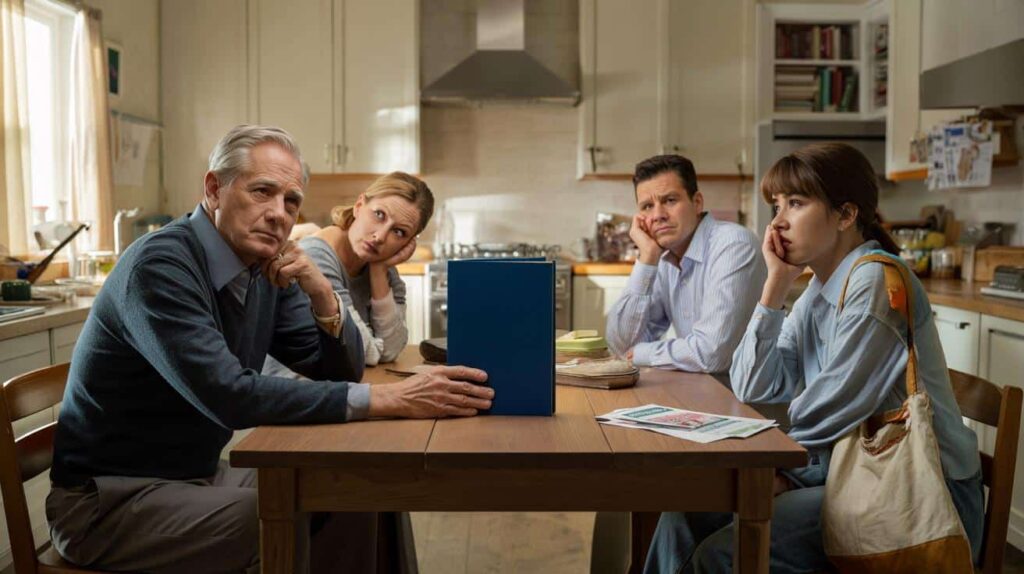
Like a thousand other arguments in family kitchens, this one started over coffee. The 72-year-old father quietly slid a blue folder across the table. It was his will. His two daughters looked at each other, his son stared at the cover, and his wife looked at his face instead of the paper. He said, “I’ve split everything up evenly.” “Three kids, three equal parts.” He sounded proud, like he had just done the right thing in the world.
His wife didn’t smile. She took a breath and said, “It’s not fair to be equal.” One daughter makes less money than the others. The son is still in a lot of debt from school. One child married someone who was rich, but the other two didn’t. The father looked confused and maybe even hurt. To him, “equal” meant “fair,” plain and simple. To her, it meant acting like those differences didn’t matter.
The room got very quiet. That’s where a lot of families are right now: stuck between maths and reality.
 The “grandparent habit” that psychologists say creates the strongest bond with grandchildren
When “equal shares” don’t match up with real life
It looks neat on paper to divide everything evenly between two daughters and a son. It feels safe, and even good. You worked hard, raised three kids, and don’t want to pick favourites. People say the same thing over and over: “I’ll treat them all the same.” The father in this story thought he was avoiding drama by doing just that.
But life doesn’t split up so easily. One of the kids could have a disability. Someone else may have given up their job to take care of their ageing parents. One sibling could own a house outright while the other is just one pay cheque away from being kicked out. Equal pieces of the pie end up on very different plates. That’s when the tension starts to build, long before any lawyer reads a will out loud.
A lot of parents believe that treating everyone the same will keep them from being accused of favouritism. It seems like a good thing to do. But when a spouse looks at the numbers and says, “this isn’t fair,” she’s usually talking about something more subtle. She sees the small sacrifices, the help that isn’t obvious, and the emergencies that are taken care of in the background. To her, fairness isn’t a calculator. It’s a memory of who carried what.
Inside one family’s quiet battle over “equal” inheritance
Lina, the oldest daughter in this family, is a corporate lawyer who lives well with her partner, who also makes a lot of money. Sam, the middle child, went from contract to contract and is now a single father. He is still paying off a loan he took out to keep his business going during the pandemic. Eva, the youngest, teaches in a small town. She’s happy, but her salary is low and she doesn’t have any savings.
Their mother knows all of this. She sees that Eva sent money she could barely spare when the roof leaked. She remembers the months when Sam stayed with her overnight to help her after her surgery. Lina loves her parents, but she lives far away and is busy with meetings and flights. None of this is sad or dramatic. It’s just the feel of a normal family, but it’s stretched out in three ways.
So when she hears “each gets one-third,” her brain quickly does the maths. One-third goes to the daughter, who already owns two apartments. One-third for the son, who may have to sell his share just to stay alive. One-third for the teacher who might never be able to stop working. The numbers are the same, but the facts aren’t. It’s not about greed that she’s protesting. It’s about the feeling that the will, as written, wipes out the stories behind each bank account.
Why fairness feels dangerous and equality feels safe
There is a reason why so many parents choose to split things evenly. It keeps you from feeling bad when you say, “This child needs more than the others.” It avoids the worry that the wealthier child will be hurt or the less fortunate one will feel sorry for themselves. You can use a number to show that equality is a shield. I loved you all the same.
But in a family, money is never just money. It’s love, guilt, thanks, anger, and an apology. When a spouse questions a “equal” will, what she really wants to know is if we are brave enough to admit that our children live with an unfair situation. Should we write that into the final document, which we can’t change after we’re gone? A lot of parents are scared to answer that question.
To be honest, not many people have these talks early and often. Most people put them off and then rush to get a will done with a lawyer in one afternoon. The end result is a document that looks neat but is based on years of things that were never said. *A neat signature can hide a messy family secret.* That space between the ink and the truth is where a lot of inheritance fights start.
How to talk about “equal vs. fair” without ruining Christmas
The easiest thing to do is also the hardest: say what everyone else already knows. You don’t have to start with numbers. Begin with facts. “You make good money and are safe.” “You’ve had a rough time at work.” “You did most of the caring when Dad was sick.” Naming these truths doesn’t make things unfair; it just acknowledges what is already there.
From there, a parent can talk about their gut feeling. “My first thought is to break everything up into three parts.” Then, especially if a spouse disagrees, they can gently say, “But your mother and I are wondering if that really reflects what each of you might need.” It’s not a speech for court. It’s a talk in the kitchen, probably with some awkward pauses and bad jokes to break the tension.

One useful thing to do is write a short letter to go with the will. Just a note from a person, not a legal essay. “We chose this distribution because…” That letter won’t make kids feel better, but it does give them something important: context. They might not agree, but at least they don’t have to make up stories in their heads about who was loved more.
What a lot of parents get wrong when they say they “don’t want any problems”
A lot of the time, parents say, “I don’t want them to fight, so everything is fair.” It makes sense, but silence is usually what starts the fire. When kids find out the details only after someone dies, they feel everything at once: sadness, shock, and old rivalries that never got resolved. That will become a lightning rod for emotions that have been around for decades, no matter what.
Some parents, on the other hand, go too far and try to “fix” every inequality with maths. They think about who got help with their down payment, who had their school fees paid, and who moved back home. That way leads to insanity. A spreadsheet can’t show how much a late-night phone call or five years of unpaid care work are worth. Trying to settle every score in a will will probably make things worse, not better.
A more compassionate approach is to acknowledge that a flawlessly equitable division will never exist. The goal changes from “no one can complain” to “everyone understands the reasoning.” You won’t be able to get rid of all the jealousy or disappointment. But you can make it less harsh by showing that your choices weren’t random or secret. When the people you love are already hurting, that alone is worth a lot emotionally.
Voices, phrases, and a simple way to get around your own family
Lawyers’ clean language is not something that families use very often. They say things like, “Look, you’re doing fine, you don’t need as much,” or “You already married into money, you’ll be fine.” Even if they are true, these words can hurt. A more polite way to say it might be: “We see that your situation is safer, and we’re trying to give each of you a chance to feel safe.”
A financial planner I spoke with told me that parents know which child is having a hard time but are afraid to say it out loud. They are afraid that by giving the successful child “less,” they will hurt their feelings. The funny thing is that a lot of those successful kids would actually like that honesty. They don’t want to see their siblings fail while acting like everyone started from the same place.
He said, “Fair doesn’t always mean equal.” “Fair” in families often means being honest, explaining things, and coming from a place of love rather than guilt.
- Think about this: are you choosing equality to avoid feeling bad, or because it really fits your kids’ lives?
- In your own words, write a short letter explaining your will that will go with it.
- Talk to your spouse about where you disagree in a calm and sober way at least once.
- Think about making small changes, like giving the child with fewer resources a little extra money or a life insurance policy.
- Accept that some disappointment is normal; your job is to be clear, not to make everyone happy.
Leaving a message and some money
An inheritance is never just a transfer of property. It’s the last big thing parents tell their kids about how they saw them, what they valued, and what they were willing to say. Giving each of your three children the same amount of everything can show them that you see them all the same. When you adjust things based on need, you can say, “I saw your specific path and tried to meet you where you were.”
There is no automatic right answer for either version. The real question is which truth makes you feel better about living your life. The dad in that kitchen thought he was choosing peace by being fair. His wife was brave enough to say out loud what many partners keep to themselves: peace built on denial doesn’t last. There is a version of fairness that will feel honest, if not perfect, somewhere between the two instincts they have.
Every family that cares about this question is already doing something unusual: they are treating money as part of the emotional story, not just a number to divide. That alone can change how the next generation handles its own wills, its own blue folders on kitchen tables, and its own choice between fair and unfair maths.
| Main point | Detail | What the reader should know |
|---|---|---|
| Fair vs. equal | Equal shares can overlook the actual disparities in siblings’ circumstances. | Asks readers to think about whether “equal” really describes their family |
| Talk before you sign | Early, honest talks are better at stopping fights than “fair” rules that don’t say anything. | Gives you a way to stop future drama and anger in a practical way |
| Tell me why you made your choices | A short personal letter with the will gives context and care. | Makes it easier to accept your choices, even if they hurt. |